
Converter Meter to Square Feet: Get the Right Area Conversion
Convert square meters to square feet with accurate formulas and examples. Learn when meter measurements need a width, plus tables, room calculations, and tips.
Modern apartment blueprint on wood table with yellow metric tape measure and ceramic floor tile samples
Table of Contents (22 sections) ▼
- Quick Answer: Convert Area With the Area Factor
- Check Whether Your Input Is Length or Area
- The Exact Relationship Between Square Meters and Square Feet
- Using a Converter Meter to Square Feet Tool
- Calculate Square Footage From Room Dimensions in Meters
- Convert Centimeter Measurements and Irregular Areas
- A Rug Measured in Centimeters
- A Floor With a Rectangular Cutout
- A Circular Surface
- Square-Meter-to-Square-Foot Reference Table
- Reverse the Conversion and Keep Rounding Under Control
- Compare Coverage and Prices on the Same Basis
- Avoid Changing the Meaning of a Floor-Plan Number
- Frequently Asked Questions
- How Many Square Feet Are in One Square Meter?
- Can You Convert Meters Directly to Square Feet?
- Is 10 Meters the Same as 10 Square Meters?
- What Is 25 Square Meters in Square Feet?
- Should I Multiply by 3.28 or 10.76?
- Do Square Meters and Meters Squared Mean the Same Thing?
- Does Converting Area Tell Me How Much Material to Buy?
- Match the Unit Before Applying the Formula
A floor area of 23 square meters equals about 247.57 square feet. But a wall that is 23 meters long needs a height measurement before you can work out its area. Before using a converter meter to square feet, check which type of measurement you have.
Square meters measure area, so you can convert them directly to square feet by multiplying by approximately 10.7639. Meters measure length. If your room dimensions are in meters, multiply the length by the width first, then convert that area into square feet.
The difference matters when ordering flooring, checking a property listing, or measuring a wall for tiles. Getting the units right gives you a useful result for the space you actually need to cover. This guide explains the calculation with worked examples, a conversion table, and instructions for entering your measurements correctly.
Quick Answer: Convert Area With the Area Factor
Multiply square meters by 10.7639104167 to obtain square feet, or divide by 0.09290304. For a rectangle measured in meters, first multiply length by width to find square meters, then convert. A single length in meters cannot determine square footage unless another dimension or a shape condition is supplied.
Check Whether Your Input Is Length or Area
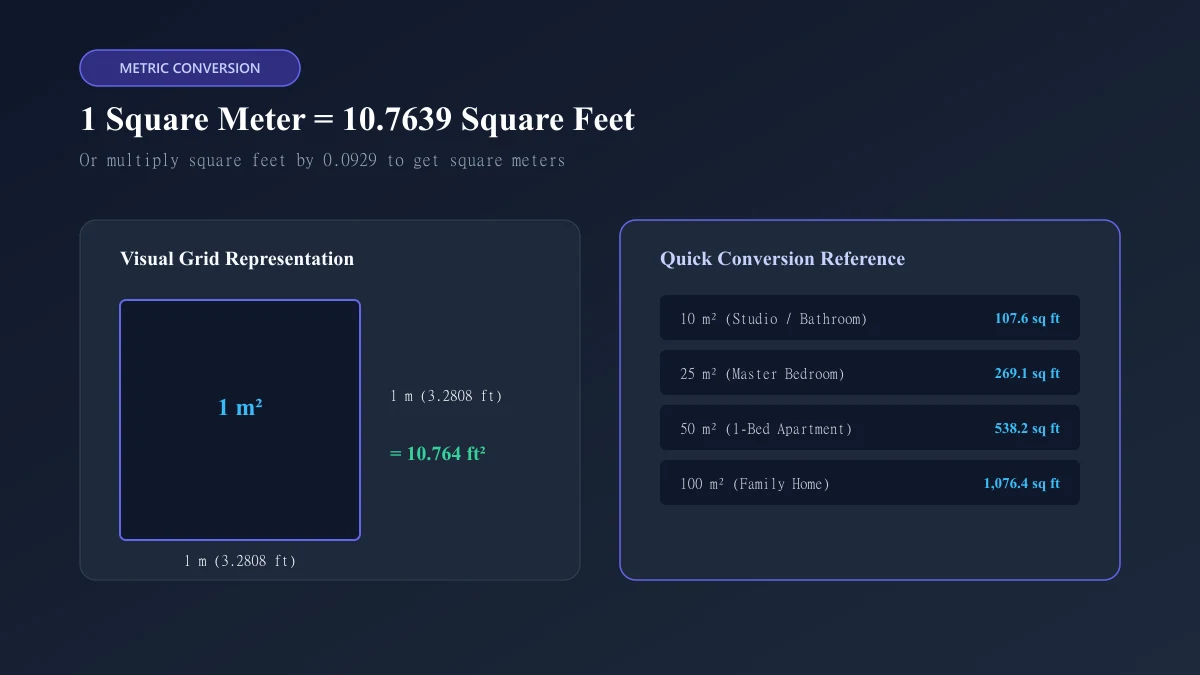
A meter measures length. A square meter measures area. They describe different quantities, even though both contain the word meter.
One square meter is the area of a square measuring one meter on each side. It does not mean a perimeter of one meter, and it does not require every measured space to be square. A rectangle measuring 2 meters by 0.5 meter also has an area of 1 m².
Watch for these labels:
| Label on a plan or product | Meaning | What you can do next |
|---|---|---|
| m, meter, linear meter | Length | Convert to feet or combine with another dimension |
| m², sqm, sq m | Area in square meters | Convert directly to square feet |
| ft², sqft, sq ft | Area in square feet | Convert directly to square meters |
The phrase “meter square” can be unclear in casual writing. Look for the unit symbol or ask what was measured before treating the number as an area.
For US English, the spelling is meter. Square metre is the British spelling of the same unit and uses the same conversion.
The Exact Relationship Between Square Meters and Square Feet
The international foot equals exactly 0.3048 meter. Squaring that relationship gives:
NIST lists this square-foot-to-square-meter conversion. Reversing it gives:
To convert an existing area, use:
Or use the convenient rounded multiplier:
The first expression uses the exact decimal relationship. The second uses a rounded conversion factor that is suitable for most everyday calculations.
Here is the opening example in full:
23 m² ÷ 0.09290304 ≈ 247.56994 ft²
Rounded to two decimal places, the answer is 247.57 ft². The room has not grown; the smaller unit simply produces a larger numerical value for the same area.
The factor for meters to feet is approximately 3.28084. It applies to length. Area uses its square, which is why multiplying square meters by 3.28084 would be incorrect.
Using a Converter Meter to Square Feet Tool
A square meter to square foot converter needs one area value. A room calculator needs dimensions. Choose the input type that matches your measurements.
For an existing floor area:
- Confirm that the value is in m² rather than m.
- Select square meters as the input unit.
- Enter the area without changing its unit first.
- Read the square-foot result and its rounding.
For room dimensions, choose a square footage calculator that accepts metric lengths. Enter length and width separately and check that both fields are set to meters.
Do not enter 4.8 × 3.2 as one number unless the tool supports expressions. In a converter that asks for area, calculate the product first. In a dimensions-based calculator, use separate fields.
A useful check is to enter 1 m². The result should be about 10.7639 ft². If it shows about 3.28084 feet, you are using a length converter rather than an area converter.
Zero area converts to zero area. A negative result usually indicates an input or subtraction mistake in an ordinary room-measurement task.
Calculate Square Footage From Room Dimensions in Meters
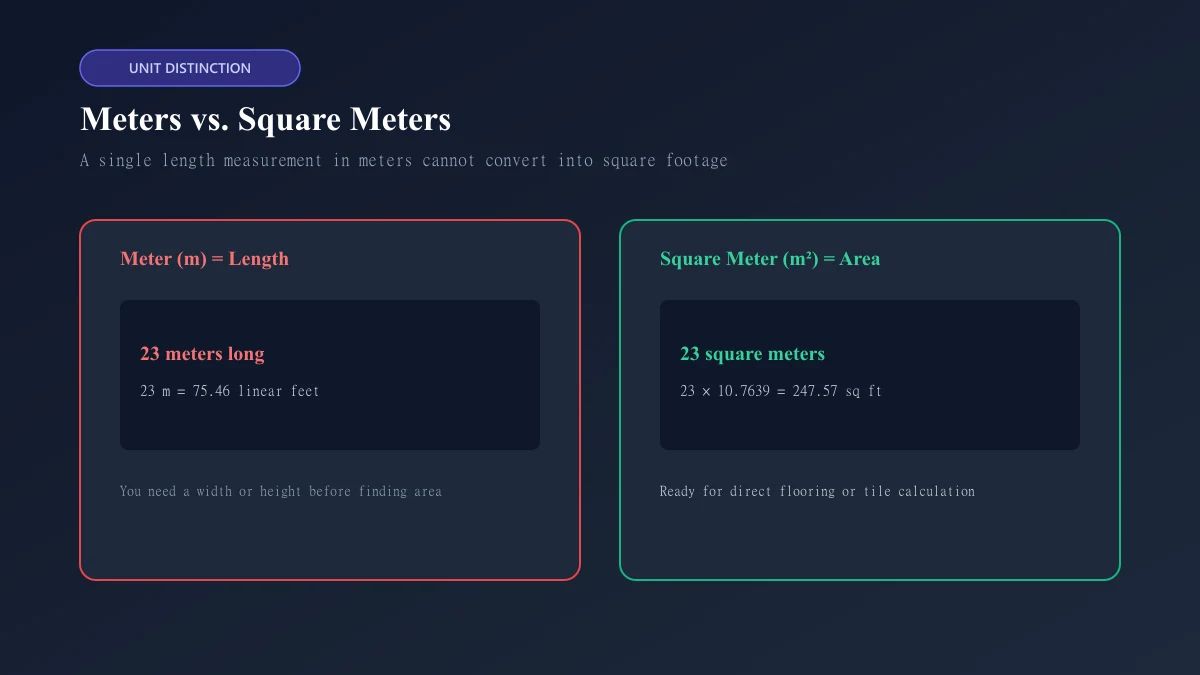
Here is how to calculate square feet from meters when you have the dimensions of a rectangle.
Suppose a room measures 4.8 meters long and 3.2 meters wide:
Convert that area:
15.36 ÷ 0.09290304 ≈ 165.33 ft²
You can also convert each side to feet and multiply, but keep enough digits in both converted lengths. Converting the completed metric area is often simpler and avoids rounding each dimension prematurely.
Measure the surface you actually need. For flooring inside a room, use the relevant interior floor dimensions. For wall coverage, use wall length and height. The same area-conversion factor applies, but the measurements describe a different surface.
Furniture sitting on a floor does not automatically reduce the flooring quantity. Whether you subtract a feature depends on whether the material will be installed beneath or around it. Decide that before subtracting areas.
Convert Centimeter Measurements and Irregular Areas
A Rug Measured in Centimeters
A rug measures 180 cm by 240 cm. Convert both dimensions to meters:
Alternatively, its area is 43,200 square centimeters. Divide by 10,000 to obtain 4.32 m², then convert to square feet. There are 10,000 cm² in 1 m² because 100 × 100 equals 10,000.
A Floor With a Rectangular Cutout
Assume a floor fits within a rectangle measuring 5.6 m by 4.2 m, with a rectangular section measuring 1.4 m by 1.2 m excluded:
Converted area ≈ 235.08 ft²
Subtract in one consistent unit, then convert the result. If you divide an irregular floor into rectangles instead, ensure the sections do not overlap.
A Circular Surface
For a circle, area equals πr², where r is radius. A circular surface with a radius of 2 meters has:
Converted area ≈ 135.26 ft²
The shape formula changes, but the sqm to sqft conversion does not. Once an area is known in square meters, the same factor applies to rectangles, circles, and other shapes.
Square-Meter-to-Square-Foot Reference Table
This m² to ft² table uses the standard conversion and rounds the results to two decimal places.
| Square meters | Square feet |
|---|---|
| 1 m² | 10.76 ft² |
| 3 m² | 32.29 ft² |
| 8 m² | 86.11 ft² |
| 12 m² | 129.17 ft² |
| 18 m² | 193.75 ft² |
| 35 m² | 376.74 ft² |
| 60 m² | 645.83 ft² |
| 90 m² | 968.75 ft² |
| 150 m² | 1,614.59 ft² |
Use the table to check the scale of an answer. For example, a result near 30 ft² for 35 m² would be far too small. Since one square meter is larger than one square foot, converting m² to ft² increases the numerical value.
If your exact area falls between the listed rows, calculate it directly. Rounding a measured area to a nearby table entry may introduce more error than rounding the final converted answer.
Reverse the Conversion and Keep Rounding Under Control
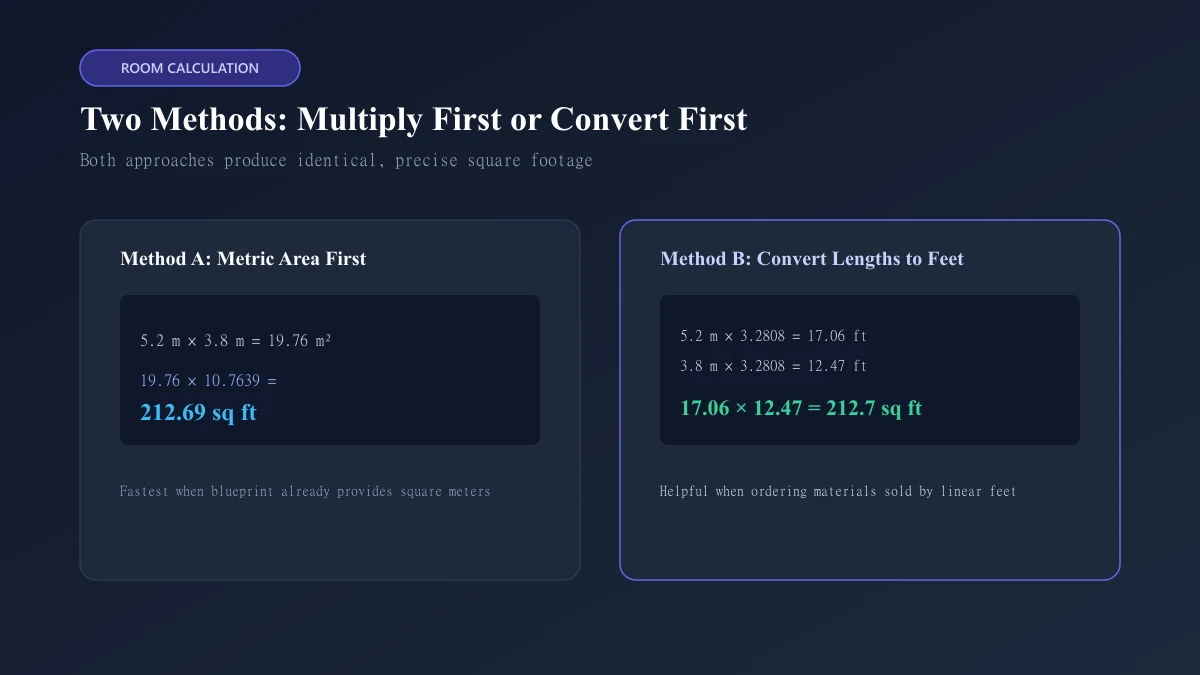
For square feet to square meters, multiply by 0.09290304:
A surface measuring 420 ft² is:
Report about 39.02 m² when two decimal places are useful.
Round at the end rather than after each step. The rounded factor 10.76 is convenient for quick estimates, but it is slightly below the fuller factor. At 1,000 m²:
Using 10.76 gives 10,760 ft²
Using the fuller factor gives about 10,763.91 ft²
The difference is about 3.91 ft². That may be small for a rough size comparison, but repeated rounding is unnecessary when a calculator can retain more digits.
Input precision also matters. A floor measured only to the nearest tenth of a meter should not be presented as though its converted area were surveyed to many decimal places. The conversion can be precise while the original measurement remains approximate.
Compare Coverage and Prices on the Same Basis
Area conversion helps when one material label uses m² and another uses ft². Convert the coverage figures to a common unit before comparing them.
Suppose a package covers 2.2 m²:
For a measured surface of 17 m², the basic package count is:
17 ÷ 2.2 ≈ 7.73 packages
If only whole packages are sold, that rounds up to eight before any project-specific allowance. The conversion itself does not decide an allowance for cuts, patterns, or unusable pieces.
Price per square meter converts differently from the area number because area is in the denominator. Assume a hypothetical material price of $32 per m²:
Check the total using unrounded values. Covering 17 m² at $32 per m² costs $544 before other charges. Converting the area and unit price should preserve that total, apart from rounding.
For the reverse price comparison, multiply a price per square foot by 10.7639104167 to obtain price per square meter. Compare the same product coverage and clarify whether the quote includes installation, delivery, or other charges.
Avoid Changing the Meaning of a Floor-Plan Number
Unit conversion preserves the area that was originally supplied. It does not establish which spaces were included in that area.
For example, a plan showing 72 m² converts to approximately 775 ft². That answer still refers to the same stated 72 m². It does not tell you whether the measurement includes wall thickness, balconies, storage areas, or shared spaces.
When comparing plans or listings, confirm the measurement basis as well as the unit. A converted total and a separately measured usable floor area can differ even when both calculations are correct.
Also separate perimeter from area. A rectangular space measuring 7 m by 2 m has an area of 14 m² and a perimeter of 18 m. Multiplying that perimeter by the square-meter conversion factor would not produce its floor area.
Keep the original figure, unit, and description alongside the converted result. That makes a comparison easier to review and helps prevent an area value from being mistaken for a room dimension.
Frequently Asked Questions
How Many Square Feet Are in One Square Meter?
One square meter equals approximately 10.7639 square feet. The exact relationship in the opposite direction is 1 ft² = 0.09290304 m². Multiply any area in square meters by the approximate factor, or divide it by 0.09290304, to express the same physical area in square feet.
Can You Convert Meters Directly to Square Feet?
A single length in meters cannot determine an area in square feet. You need another dimension, or a condition that supplies it. For example, a square with a side of 3 meters has an area of 9 m². A line measuring 3 meters alone has no specified surface width.
Is 10 Meters the Same as 10 Square Meters?
No. Ten meters is a length, while ten square meters is an area. A square measuring 10 meters on each side has an area of 100 m². A rectangle measuring 5 meters by 2 meters has an area of 10 m². The unit determines what the number describes.
What Is 25 Square Meters in Square Feet?
Twenty-five square meters equals approximately 269.10 square feet. Calculate 25 ÷ 0.09290304, then round the result as needed. This conversion gives the same area in another unit; it does not reveal the room’s length and width. Several different room shapes can have an area of 25 m².
Should I Multiply by 3.28 or 10.76?
Use approximately 3.28 to convert a length in meters to feet. Use approximately 10.76 to convert an area in square meters to square feet. The area factor is the square of the length factor. For more accurate area results, divide square meters by 0.09290304 instead of using a short rounded multiplier.
Do Square Meters and Meters Squared Mean the Same Thing?
Both can describe an area unit when written as m². However, “a 4-meter square” describes a square with sides 4 meters long, giving 16 m². “Four square meters” describes an area of 4 m². Read the wording carefully, especially when a dimension and an area could be confused.
Does Converting Area Tell Me How Much Material to Buy?
It gives the area in the unit used by the product or supplier. The purchase quantity also depends on package coverage, layout, cuts, and any required allowances. First calculate the measured surface area, then apply the product’s coverage information. Keep extra material and whole-package rounding separate from the unit conversion.
Match the Unit Before Applying the Formula
A converter meter to square feet is useful once you know whether the input is a length or an area. Convert m² directly with the area factor. For dimensions in meters, calculate the surface area first. Retain enough digits during the calculation, round the final result sensibly, and compare values that describe the same measured space.
Related Topics
Written by BigTechies Editorial Team
BigTechies develops accurate, practical calculation and unit conversion tools for contractors, designers, architects, and DIY homeowners. Every formula and reference guide is reviewed for dimensional consistency and mathematical precision.
Related Articles
Continue exploring practical measurement guides
 Volume & Area
How Many Sq Feet in a Cubic Foot? Coverage Depends on Depth
Find how many square feet one cubic foot covers at different depths. See a clear coverage chart, bag examples, and why area and volume have no fixed conversion.
 Volume & Area
How Do I Find the Cubic Feet? A Practical Measuring Guide
Learn how to find cubic feet from feet, inches, or metric measurements. Get clear examples for boxes, rooms, cylinders, and spaces with uneven dimensions.
 Material Estimation
Linear Foot Square Foot Calculator: Convert Length and Area
Use a linear foot square foot calculator to convert length and area with material width. See formulas, flooring examples, price comparisons, and ordering tips.
Calculate Your Project in Seconds
Whether you're pouring concrete, spreading garden mulch, or estimating freight container volume, our instant calculator provides exact answers with zero guesswork.