
How Do I Find the Cubic Feet? A Practical Measuring Guide
Learn how to find cubic feet from feet, inches, or metric measurements. Get clear examples for boxes, rooms, cylinders, and spaces with uneven dimensions.
Architect measuring empty renovated room with digital laser distance meter and tape measure
Table of Contents (21 sections) ▼
- Quick Answer: Match the Measurements to the Shape
- Decide Which Volume You Need Before Measuring
- How Do I Find the Cubic Feet From Tape Measurements?
- Calculate Cubic Feet From Inches
- Handle Feet-and-Inches and Metric Measurements
- Feet and Inches Together
- Metric Dimensions
- Measure Circular Containers Using Radius
- Divide Awkward Spaces Into Measurable Sections
- Use Average Height Only When the Shape Supports It
- Check Calculator Inputs and the Result’s Meaning
- Report a Useful Estimate Rather Than False Precision
- Frequently Asked Questions
- Can I Find Cubic Feet From Square Feet?
- How Do I Measure Refrigerator Cubic Feet?
- Why Do I Divide Inch Measurements by 1,728?
- Can I Find Volume From Length and Width Alone?
- Are Cubic Feet the Same as Cubic Yards?
- Does the Outside Volume Tell Me What Fits Inside?
- What If the Object Is Not a Regular Shape?
- Start With the Boundary You Actually Want to Measure
To find cubic feet of a rectangular object or space, measure its length, width, and height in feet, then multiply all three. If you are asking “how do I find the cubic feet” from measurements in inches, multiply them together and divide by 1,728 instead.
That answers the arithmetic, but the measurements must describe the space you actually want. The outside of a container tells you how much room it occupies. The inside tells you its approximate capacity. A round tank needs a different formula, and a sloped ceiling needs more than one height measurement.
Start by deciding what you are measuring and recognizing its shape. Then record the dimensions with their units before reaching for a calculator. The methods below cover ordinary boxes, mixed feet-and-inches measurements, circular containers, and spaces that need to be divided into smaller sections.
Quick Answer: Match the Measurements to the Shape
For a rectangular space, cubic feet equal length × width × height when all measurements are in feet. With all dimensions in inches, divide their product by 1,728. Measure inside for capacity and outside for occupied space. For cylinders, use π × radius² × height, with radius and height in feet.
Decide Which Volume You Need Before Measuring

A cubic foot is the volume of a cube measuring one foot along each edge. It describes three-dimensional space and is written as ft³, cu ft, or cubic feet.
However, an object can have several useful volume measurements. A shipping box has an outer volume, an inner capacity, and a smaller amount of space left after packing materials are added.
Choose the measurement that fits your purpose:
| Your purpose | Measurements to use |
|---|---|
| Find container capacity | Internal measurements |
| Estimate the space a packed box occupies | External dimensions after packing |
| Measure air space in a room | Room dimensions, allowing for its actual shape |
| Find the volume of contents | Their actual fill depth or occupied dimensions |
Do not use the full height of a container when it is only partly filled. Likewise, a cabinet’s outside dimensions include panels and other features that reduce its interior storage capacity.
Make a small sketch if the boundary is unclear. Mark the space being measured and label each dimension. This is especially helpful when you need to subtract a fixed obstruction or distinguish a room’s footprint from its usable height.
How Do I Find the Cubic Feet From Tape Measurements?
For a box-shaped space, the cubic feet formula is:
V is volume in cubic feet. L, W, and H are length, width, and height in feet.
To measure reliably:
- Identify three directions that meet at right angles.
- Measure along straight edges or parallel boundaries.
- Write each value with its unit immediately.
- Convert the dimensions to feet, or use the all-inch method.
- Multiply and label the result ft³.
Avoid diagonal measurements across the floor or through a box. A diagonal is not a substitute for length, width, or perpendicular height.
For example, a rectangular compartment measuring 4.5 feet long, 2 feet wide, and 1.25 feet high has:
The decimal measurements are already in feet, so no further unit conversion is needed. A value of 1.25 feet means 1 foot 3 inches, not 1 foot 25 inches.
If a tape measure is difficult to keep straight, measure twice. A bowed tape or a reading taken at an angle can change the result before any arithmetic begins.
Calculate Cubic Feet From Inches
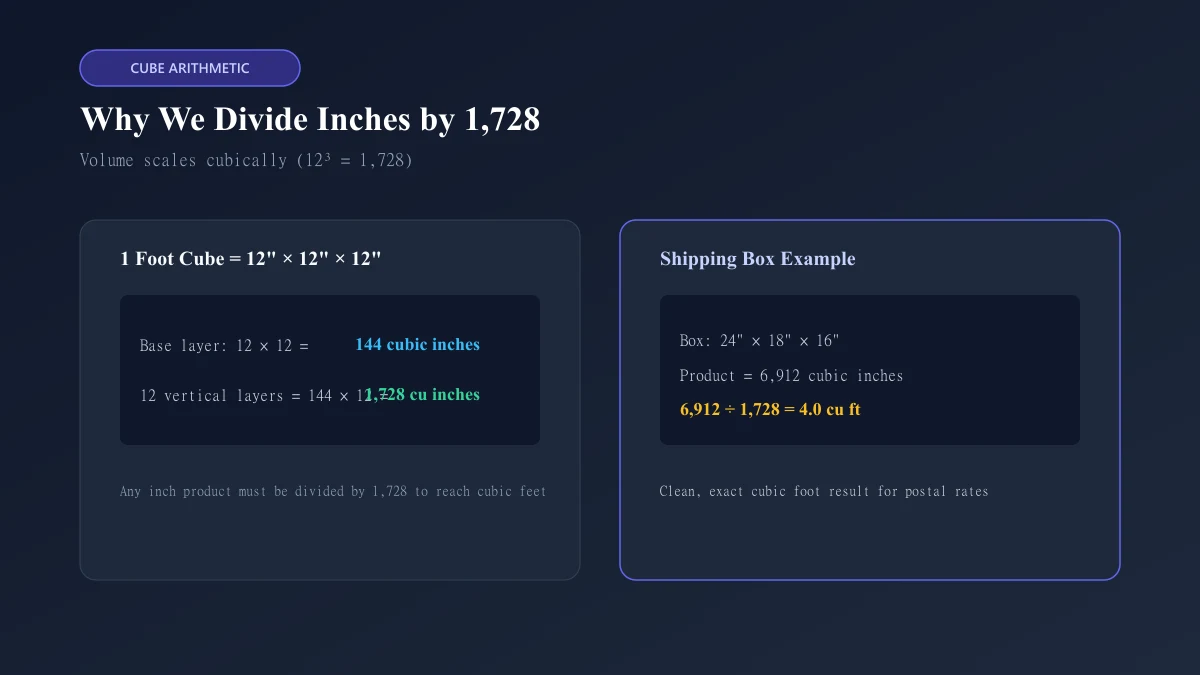
The all-inch shortcut is useful for small containers and objects:
The divisor comes from 12 × 12 × 12. One cubic foot contains 1,728 cubic inches, so dividing by 12 only once does not complete the conversion.
Here is how to measure cubic feet of a box with external dimensions of 28 inches by 20 inches by 15 inches:
This is the box’s outer rectangular volume. To calculate its inside capacity, replace those values with internal dimensions.
Converting cubic inches to cubic feet after multiplying usually avoids awkward repeating decimals in the individual dimensions. You can also divide each measurement by 12 first; both approaches are equivalent when calculated correctly.
Keep the unrounded result until the end. Rounding every converted edge to one decimal place can noticeably alter the final volume, especially for smaller objects.
Handle Feet-and-Inches and Metric Measurements
Feet and Inches Together
Convert each measurement using:
Suppose a compartment measures 3 feet 8 inches long, 2 feet 3 inches wide, and 1 foot 6 inches high.
Its dimensions in feet are:
Therefore:
For a practical estimate, report about 12.38 ft³. Entering 3.8 feet for 3 feet 8 inches would be incorrect because inches are twelfths of a foot, not tenths.
Metric Dimensions
If you measure in centimeters, multiply to obtain cubic centimeters, then convert that volume:
A rectangular space measuring 90 cm by 55 cm by 40 cm has:
For cubic meters to cubic feet, multiply by approximately 35.3147. The same volume is 0.198 m³, which gives approximately 6.99 ft³ again.
Do not multiply a length in centimeters by widths and heights in feet. Convert first or use a tool that clearly supports separate units for each input.
Measure Circular Containers Using Radius
Finding cubic feet of a cylinder requires the radius and height:
Here, r is radius in feet, h is perpendicular height in feet, and π is approximately 3.14159. Radius is half the diameter measured across the circle.
Suppose a straight-sided cylindrical container has an internal diameter of 30 inches and an internal height of 48 inches.
Convert the measurements:
Then calculate:
That represents the full interior cylinder. If it is filled only 30 inches deep, substitute 2.5 feet for the height instead of 4 feet.
Using diameter where the formula requires radius makes the answer four times too large. Also check that the container really is cylindrical. A tapered bucket changes width with height, so one diameter cannot describe it accurately.
For a horizontally positioned cylinder that is partly filled, liquid depth cannot simply replace the cylinder’s length. The filled cross-section is a circular segment and needs a suitable tank calculation.
Divide Awkward Spaces Into Measurable Sections
Here is how to find cubic feet of an irregular shape when its boundaries can be represented by simpler solids.
One approach is to calculate an enclosing rectangular space and subtract an obstruction. Suppose an alcove measures 6 feet wide, 3 feet deep, and 8 feet high:
A fixed rectangular column occupies 2 feet by 0.75 foot through the full 8-foot height:
Alternatively, divide the remaining space into non-overlapping sections and add their volumes. Ensure that each section is counted once.
A sloping space can require a different model. A section with a triangular cross-section, a base of 5 feet, a perpendicular height of 3 feet, and a constant length of 4 feet is a triangular prism:
These methods are exact for the stated geometric shapes. Rounded corners, curved surfaces, and uneven boundaries make the result an approximation. Use smaller sections when one large rectangle poorly represents the space.
Use Average Height Only When the Shape Supports It
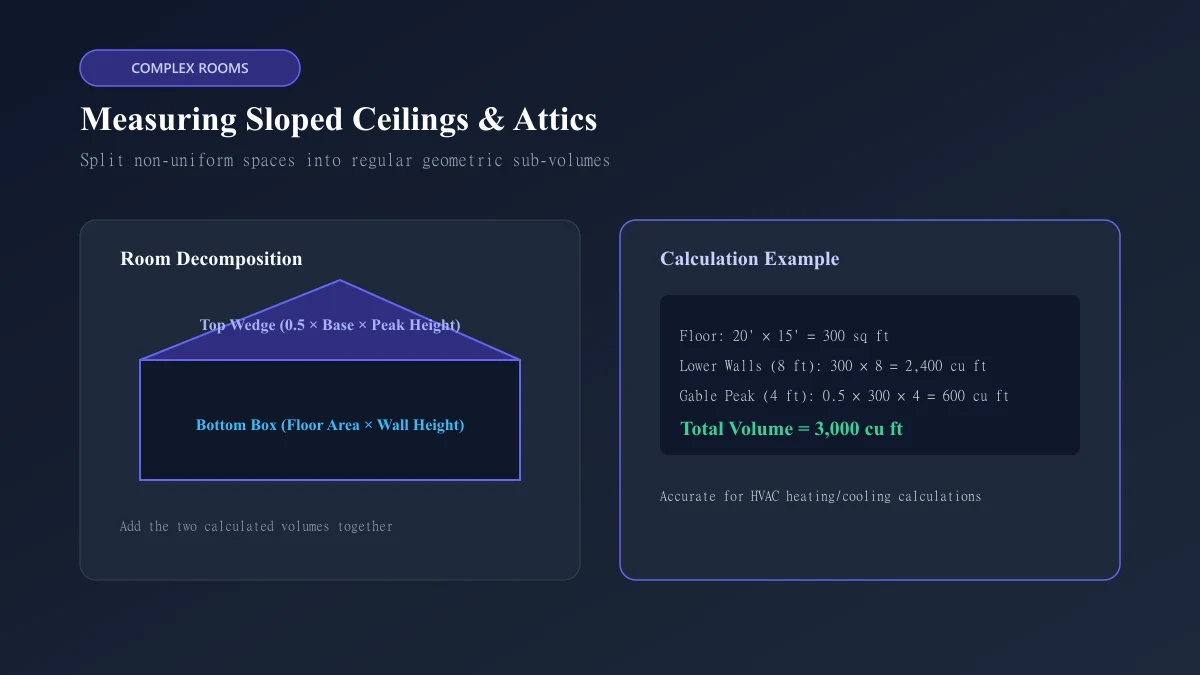
A single height measurement can misrepresent a space with a sloped roof or uneven depth.
If height changes evenly from one end to the other, average the two end heights. For a rectangular footprint 8 feet long and 3 feet wide, with height increasing linearly from 1 foot to 2 feet:
This works because the slope is straight and the width stays constant.
For an uneven pile, excavation, or surface with several dips, the average of just two readings may be misleading. Divide the footprint into smaller regions, estimate a representative depth for each, and add the region volumes.
Record which heights you measured and how you combined them. An estimate based on sparse readings should be presented as approximate. Do not attach extra decimal places simply because the calculator produces them.
Check Calculator Inputs and the Result’s Meaning
A cubic feet calculator saves time, but its shape choice and unit settings matter as much as its multiplication.
Use this short input check:
- Select the shape that matches the space.
- Identify whether the round-shape field requests radius or diameter.
- Match each dimension to its displayed unit.
- Check whether height means full height or actual fill depth.
- Confirm that the output is volume in ft³.
To see how to calculate cubic feet consistently, try a simple test with a rectangular volume measuring 2 feet by 2 feet by 2 feet. The result should be 8 ft³.
Then assess the answer in context. The cubic feet of a room describe geometric volume; they do not establish how many shelves, cartons, or furniture pieces fit. Doors, access paths, stacking limits, and the dimensions of individual objects can reduce usable space.
Likewise, cubic footage alone does not determine weight. You need density to connect a material’s volume to its mass. Keep any capacity, fit, or weight decision separate from the basic volume calculation.
Report a Useful Estimate Rather Than False Precision
Measurement uncertainty carries into the answer. If a container is approximately 40 inches long and 24 inches wide, and its height is somewhere between 18 and 19 inches, calculate both limits:
A range of about 10–10.6 ft³ is more honest than a highly precise single value based on an uncertain height. This range assumes the length and width are fixed at the stated values.
For a measured container, report the dimensions alongside the result. For a space assembled from several sections, retain the section calculations. That makes it easier to correct a reading or explain why your estimate differs from another person’s.
When ordering material, keep any additional allowance separate. The measured geometric volume and the quantity purchased answer different questions. If a supplier uses cubic yards, divide your cubic feet result by 27 after completing the measurement calculation.
Frequently Asked Questions
Can I Find Cubic Feet From Square Feet?
Yes, if you also know a consistent height or depth. Multiply square feet by height in feet to obtain cubic feet. Area alone is insufficient because it has only two dimensions. For changing depths, calculate separate regions or use an appropriate geometric model rather than assuming one height applies everywhere.
How Do I Measure Refrigerator Cubic Feet?
Use interior measurements for an approximate cavity volume, not the refrigerator’s outside dimensions. Divide the interior into manageable sections if necessary. For the appliance’s stated capacity, check the model specifications, which may list refrigerator and freezer capacities separately. A simple tape measurement is not a substitute for the manufacturer’s published rating.
Why Do I Divide Inch Measurements by 1,728?
One foot contains 12 inches, so a one-foot cube contains 12 × 12 × 12 cubic inches. That equals 1,728. Multiplying three inch measurements first gives cubic inches; dividing their product by 1,728 converts the volume to cubic feet. Dividing by 12 alone converts only one dimension’s unit factor.
Can I Find Volume From Length and Width Alone?
Length and width describe area, so a rectangular volume also needs height or depth. You can calculate volume if other information supplies that missing measurement. For round or sloped shapes, the required inputs may differ. Identify the shape and its formula before deciding whether you have enough measurements.
Are Cubic Feet the Same as Cubic Yards?
No. A cubic yard contains 27 cubic feet because each yard-long edge measures 3 feet. Multiply cubic yards by 27 to obtain cubic feet, or divide cubic feet by 27 to obtain cubic yards. Confirm the unit on a quote or container label before comparing quantities.
Does the Outside Volume Tell Me What Fits Inside?
Not exactly. Walls, insulation, handles, and internal structures can make the usable interior smaller than the enclosing outside space. Even sufficient interior volume does not guarantee that a specific object fits. Compare its dimensions with the container’s interior and opening, including any clearance needed to insert it.
What If the Object Is Not a Regular Shape?
Divide it into measurable sections if that provides a reasonable geometric model. For a small, safely immersible solid that does not absorb or react with the liquid, displacement can measure actual volume. Its enclosing box volume is a different measurement and usually overestimates the volume occupied by the solid itself.
Start With the Boundary You Actually Want to Measure
The answer to “how do I find the cubic feet” begins with identifying the space, its shape, and the units on your measurements. Use internal dimensions for capacity, external dimensions for occupied space, and the right formula for curved or sloping sections. Keep assumptions visible, round sensibly, and check that the result answers your original measurement question.
Related Topics
Written by BigTechies Editorial Team
BigTechies develops accurate, practical calculation and unit conversion tools for contractors, designers, architects, and DIY homeowners. Every formula and reference guide is reviewed for dimensional consistency and mathematical precision.
Related Articles
Continue exploring practical measurement guides
 Volume & Area
How Many Sq Feet in a Cubic Foot? Coverage Depends on Depth
Find how many square feet one cubic foot covers at different depths. See a clear coverage chart, bag examples, and why area and volume have no fixed conversion.
 Unit Conversion
Converter Meter to Square Feet: Get the Right Area Conversion
Convert square meters to square feet with accurate formulas and examples. Learn when meter measurements need a width, plus tables, room calculations, and tips.
 Material Estimation
Linear Foot Square Foot Calculator: Convert Length and Area
Use a linear foot square foot calculator to convert length and area with material width. See formulas, flooring examples, price comparisons, and ordering tips.
Calculate Your Project in Seconds
Whether you're pouring concrete, spreading garden mulch, or estimating freight container volume, our instant calculator provides exact answers with zero guesswork.