
How Many Sq Feet in a Cubic Foot? Coverage Depends on Depth
Find how many square feet one cubic foot covers at different depths. See a clear coverage chart, bag examples, and why area and volume have no fixed conversion.
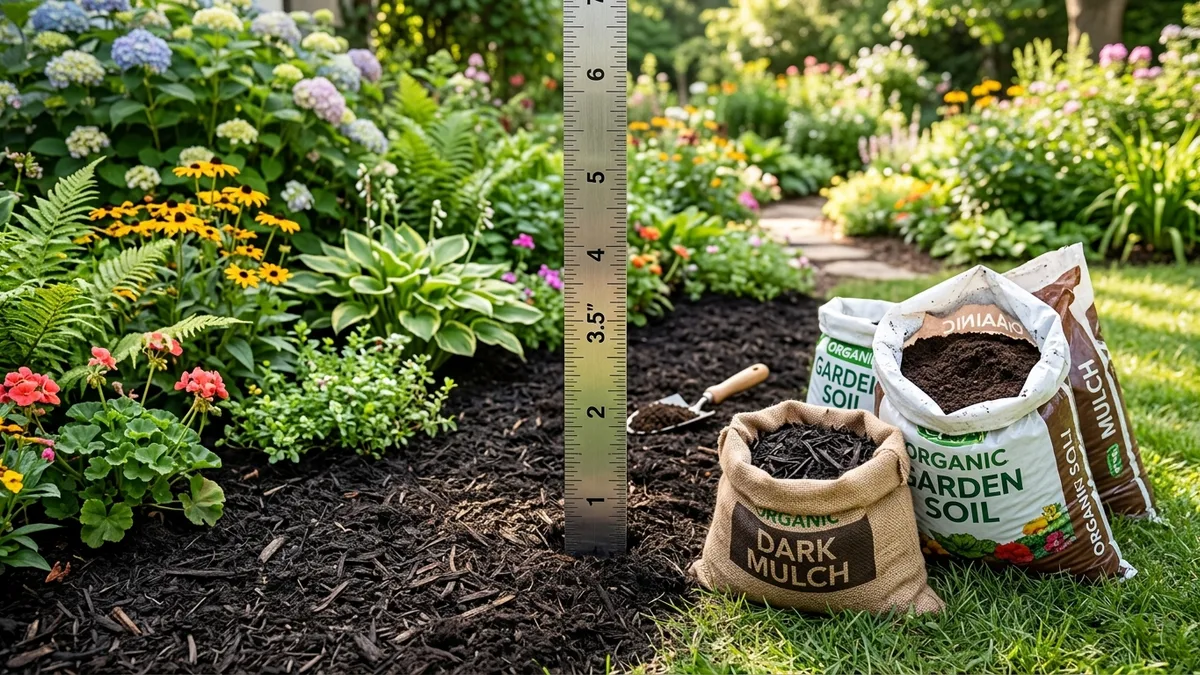
Bags of organic garden mulch and soil with stainless steel ruler measuring depth in landscaped flowerbed
Table of Contents (19 sections) ▼
- Quick Answer: One Cubic Foot Covers 12 Divided by Depth
- Why the One-Foot Cube Does Not Give a Universal Answer
- How Many Sq Feet in a Cubic Foot at Different Depths?
- Calculate Coverage From Volume and Depth
- Turn a Coverage Area Into Useful Dimensions
- Read Bag Coverage Claims With Their Depth Attached
- Decide Depth Before Trying to Stretch the Material
- Account for Uneven Depth and Changes in Material Volume
- Separate Coverage From Surface Area and Footprint
- Compare Material Costs at an Equal Depth
- Frequently Asked Questions
- Is One Cubic Foot Equal to One Square Foot?
- Does One Cubic Foot Always Cover 12 Square Feet?
- How Deep Is One Cubic Foot Spread Over 10 Square Feet?
- Does Heavier Material Cover Less Area?
- How Is a Cubic Yard Different From a Cubic Foot?
- Can I Use the Chart for Concrete?
- What Should I Enter in a Coverage Calculator?
- Keep Depth Beside Every Coverage Figure
The answer to “how many sq feet in a cubic foot” depends on the layer’s depth. One cubic foot covers 12 square feet at 1 inch deep, 6 square feet at 2 inches, or 4 square feet at 3 inches. There is no single conversion that applies at every thickness.
The question often comes up when a bag lists cubic feet but a project is measured in square feet. The bag tells you the amount of material. The area you can cover depends on how thinly or deeply you spread it.
Another source of confusion is the one-foot cube used to define volume. Its base occupies one square foot, but the same volume can form a wider, shallower layer. This guide focuses on that relationship, how to read coverage claims, and how to turn a small material volume into a realistic estimate for a measured surface.
Quick Answer: One Cubic Foot Covers 12 Divided by Depth
For one cubic foot, coverage in square feet equals 12 divided by depth in inches. At 2 inches deep, that is 6 ft²; at 4 inches, it is 3 ft². These figures assume a uniform layer and the stated usable volume. Without depth, the coverage area cannot be determined.
Why the One-Foot Cube Does Not Give a Universal Answer
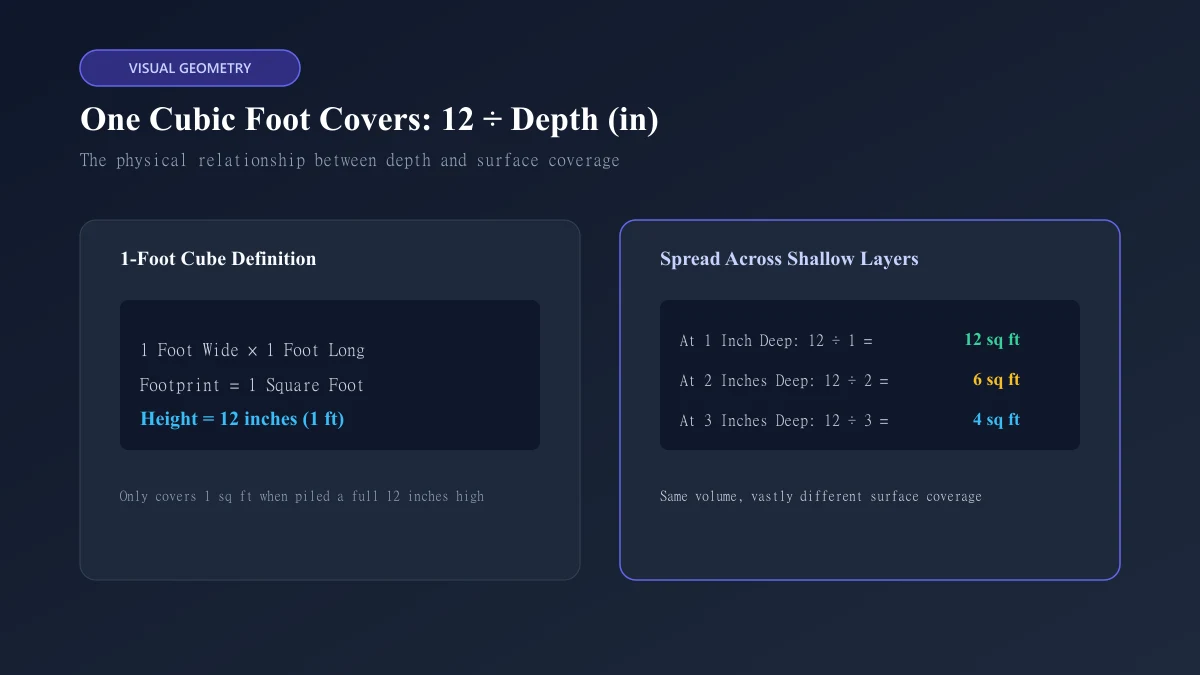
A cubic foot measures volume. A square foot measures area. The notation ft³ represents three dimensions, while ft² represents two.
Picture a cube with edges one foot long. Its footprint is one square foot, and its height is one foot. That particular arrangement explains why someone might assume one cubic foot always corresponds to one square foot.
Now imagine dividing the cube into twelve slices, each one inch thick. Every slice has a one-square-foot face. Spread those slices beside each other and they form a one-inch layer across twelve square feet.
The amount of material has not changed. Its arrangement has.
You could instead make six slices two inches thick, covering six square feet. Or make three slices four inches thick, covering three square feet. The fixed volume supports many possible areas, each paired with a different depth.
This is why a cubic feet to square feet calculation must include a third measurement. Removing depth from the question removes information needed for the answer.
How Many Sq Feet in a Cubic Foot at Different Depths?
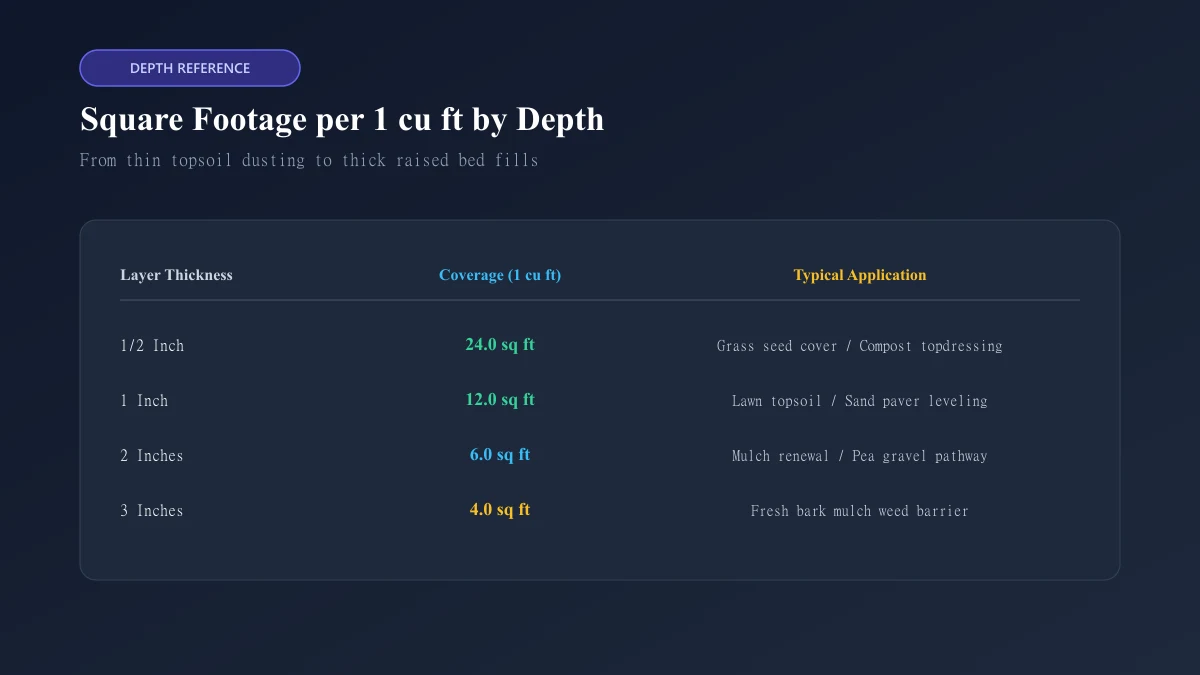
Use this cubic foot coverage chart for a uniform layer. The listed depths are calculation inputs, not recommendations for a particular material or project.
| Layer thickness | Area covered by 1 ft³ |
|---|---|
| ¼ inch | 48 ft² |
| ½ inch | 24 ft² |
| ¾ inch | 16 ft² |
| 1 inch | 12 ft² |
| 1½ inches | 8 ft² |
| 2 inches | 6 ft² |
| 2½ inches | 4.8 ft² |
| 3 inches | 4 ft² |
| 4 inches | 3 ft² |
| 6 inches | 2 ft² |
| 12 inches | 1 ft² |
The chart shows an inverse relationship: doubling depth halves coverage. Moving from a ½-inch layer to a 2-inch layer makes the layer four times deeper and reduces coverage from 24 to 6 square feet.
Very thin layers produce large mathematical coverage areas. Whether a material can actually form that layer depends on its particle size, application method, and intended use. Coarse pieces cannot necessarily create a smooth, uniform quarter-inch layer.
Calculate Coverage From Volume and Depth
The general relationship is:
A is coverage area in square feet, V is material volume in cubic feet, and d is depth in feet.
If depth is measured in inches, use:
For exactly one cubic foot, that becomes:
Suppose you want to spread one cubic foot at a thickness of 1½ inches:
Check the result by working backward:
The unit check also helps. Dividing ft³ by ft leaves ft². Dividing directly by an inch number without the factor of 12 mixes units and gives the wrong numerical result.
One cubic foot also equals 1,728 cubic inches. At a one-inch depth, that makes 1,728 square inches of coverage. Divide by 144 square inches per square foot and you obtain 12 ft², matching the formula.
Turn a Coverage Area Into Useful Dimensions
Knowing how much area 1 cubic foot covers is only the first step. A practical project also has a shape.
At 1½ inches deep, one cubic foot covers 8 ft². That area could form a rectangular strip 8 feet long and 1 foot wide, or a patch 4 feet long and 2 feet wide.
For a strip, calculate its possible length by dividing the coverage area by the strip width. Suppose you have one cubic foot and want a 3-inch-deep strip that is 9 inches wide:
That is approximately 5 feet 4 inches of strip length, assuming uniform width and depth.
The area figure does not prescribe a square shape. It can fit a rectangle, circle, or other footprint with the same area. However, gaps, curves, and boundaries affect how you measure and spread the material, so establish the actual outline before relying on a coverage number.
Read Bag Coverage Claims With Their Depth Attached
A label may show material volume, estimated coverage, or both. These values are related only when the depth is known.
For example, a hypothetical 1-cubic-foot bag claiming 6 ft² of coverage implies a depth of 2 inches:
A different label showing 4 ft² at 3 inches could describe the same material volume. The smaller coverage figure does not automatically mean the bag contains less.
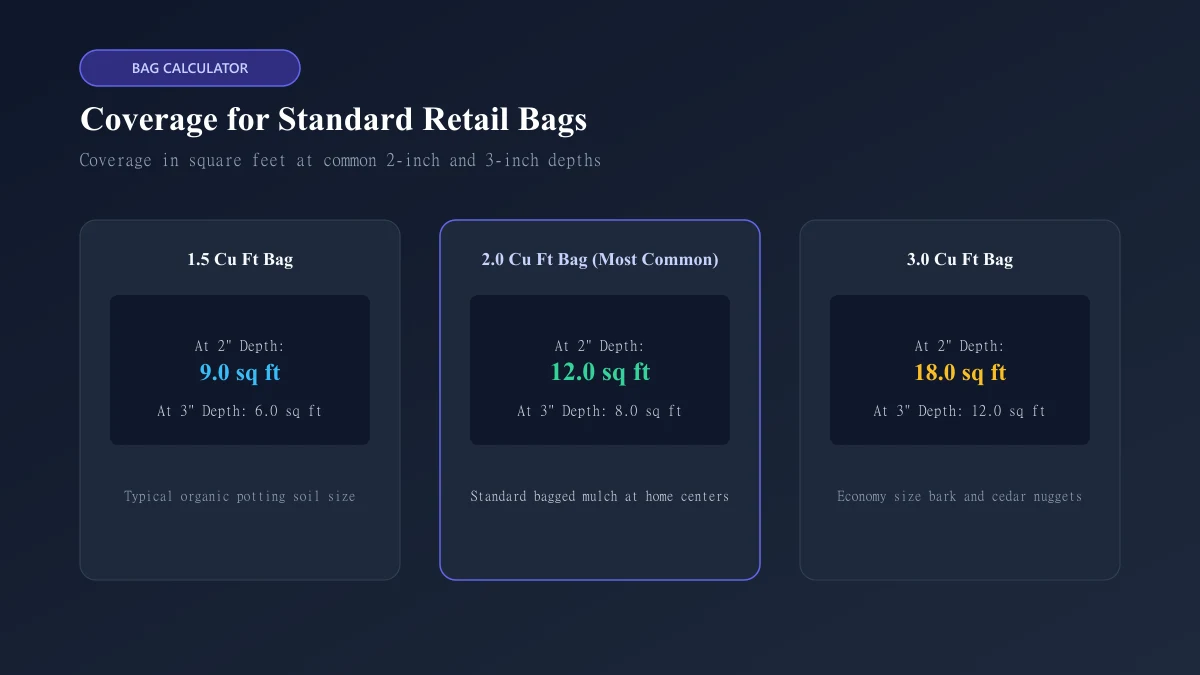
To find how many square feet a 2 cubic foot bag covers, specify the depth. At 2½ inches deep, it covers 9.6 ft².
Suppose the target surface is 22 ft² at that depth:
If only complete bags are available, purchase three before considering any separate allowance. Three bags contain 6 ft³, while the theoretical project volume is about 4.58 ft³. The difference is remaining material, not evidence that the coverage formula changed.
Read the stated depth before comparing bag coverage. Check that the volume refers to usable contents rather than the dimensions of the outside package.
Decide Depth Before Trying to Stretch the Material
A coverage calculator tells you what a chosen volume and depth can produce. It cannot decide which depth is suitable for your project.
For mulch coverage, soil coverage, or another application, choose thickness from the relevant product and project guidance first. Spreading material more thinly increases area mathematically, but may fail to provide the result you need.
Also distinguish the total desired layer from the additional layer being applied. Suppose an existing, usable layer is 1½ inches deep and you want a total of 2½ inches. The added thickness is 1 inch, assuming the existing layer is suitable and evenly distributed.
One cubic foot would then provide the additional inch over 12 ft². Calculating the full 2½ inches from new material would instead give only 4.8 ft² of coverage.
That distinction changes the order substantially. Measure the existing layer in several places before treating it as uniform. Its condition, settling, or removal may mean the nominal old depth cannot simply be subtracted from the target.
The depths used here demonstrate the calculation; they do not set a universal application thickness.
Account for Uneven Depth and Changes in Material Volume
Uniform depth is an assumption, not a guarantee. A small depression can use material that would otherwise cover another part of the surface.
Consider splitting one cubic foot into two equal portions:
- Spread 0.5 ft³ at 2 inches deep: coverage is 3 ft².
- Spread 0.5 ft³ at 4 inches deep: coverage is 1.5 ft².
Simply averaging the depths to 3 inches and applying that to the whole cubic foot would predict 4 ft². That average is inappropriate because the two covered areas are unequal.
For a combined layer, an area-weighted average depth gives the correct relationship. Here it is:
Settling and compaction introduce another issue. If loose material later occupies less volume, it may no longer maintain the same finished depth across the calculated area.
As a hypothetical illustration, suppose a loose 1 ft³ quantity occupies 0.85 ft³ after a particular treatment. At a finished depth of 2 inches, that resulting volume corresponds to:
The assumed reduction is only an example, not a recommended adjustment. Use product-specific information or measurements when loose and finished volumes differ. Avoid applying an unexplained percentage to every material.
Separate Coverage From Surface Area and Footprint
Coverage is the ground or surface area beneath a layer. It is not necessarily the total external surface area of the material.
A one-foot cube has six faces, each measuring one square foot. Its total external surface area is 6 ft², while its footprint is 1 ft². Those are properties of that cube shape.
Spread the same volume into a shallow rectangular layer and both its footprint and external surface area change. Therefore, “one cubic foot has six square feet” is only a statement about the surface of a one-foot cube. It is not a universal volume-to-area conversion.
The same distinction applies to storage. A container holding one cubic foot could have an internal base area of 2 ft² and a height of ½ foot. Another could have a base area of ½ ft² and a height of 2 feet.
Both contain the same volume. Their footprints differ because their heights differ. Always identify whether the question asks for coverage, the base footprint, or all exterior faces.
Compare Material Costs at an Equal Depth
Prices per bag or cubic foot become more useful when converted to coverage at the same thickness.
Assume a hypothetical 1 ft³ quantity costs $6. At 2 inches deep, it covers 6 ft²:
At 3 inches deep, it covers 4 ft²:
The material price has not changed. The deeper layer uses more material per square foot.
To compare another bag fairly, calculate its coverage at the same depth. A hypothetical 1.5 ft³ bag priced at $8 covers 9 ft² at 2 inches, giving about $0.89 per covered square foot.
That is a unit-cost comparison, not a complete project price. Whole-bag rounding, unused contents, delivery, and different product performance may affect which purchase makes sense. Keep the depth visible beside the price so comparisons do not accidentally mix different layer thicknesses.
Frequently Asked Questions
Is One Cubic Foot Equal to One Square Foot?
They are different measurements. One cubic foot occupies a base area of one square foot when its height is one foot. At other depths, the corresponding area changes. For example, the same volume spread 2 inches deep covers 6 square feet. State the depth before giving an area answer.
Does One Cubic Foot Always Cover 12 Square Feet?
It covers 12 square feet only at a uniform depth of 1 inch, using the full stated volume. At 2 inches, it covers 6 square feet; at 6 inches, it covers 2. Real coverage may differ if the material settles, the surface is uneven, or some contents are unusable.
How Deep Is One Cubic Foot Spread Over 10 Square Feet?
Divide volume by area to get depth in feet: 1 ÷ 10 = 0.1 foot. Multiply by 12 to express it in inches, giving 1.2 inches. This assumes the whole cubic foot is distributed evenly across all 10 square feet, without changing volume or leaving gaps.
Does Heavier Material Cover Less Area?
Not when usable volume and layer depth are the same. Coverage depends on those two measurements, not weight. Heavier material can have a greater density while occupying the same volume. Density matters when converting pounds to volume; it does not change the geometry of an already specified cubic-foot quantity.
How Is a Cubic Yard Different From a Cubic Foot?
One cubic yard contains 27 cubic feet. Its coverage at a given depth is therefore 27 times the coverage of one cubic foot. At 1 inch deep, 1 yd³ covers 324 ft². Keep the volume unit consistent when comparing a bulk order with the contents of individual bags.
Can I Use the Chart for Concrete?
Yes, as a geometric volume-and-thickness calculation. However, a bag’s weight or dry package size is not automatically its finished concrete yield. Use the stated mixed yield and the required project thickness. The chart estimates area from volume; it does not determine a structurally appropriate thickness or account for installation losses.
What Should I Enter in a Coverage Calculator?
Enter the usable volume in cubic feet and the chosen depth with its correct unit. Check any default thickness before accepting the result. If the calculator adds an allowance, distinguish that quantity from basic geometric coverage. For several depths or separate regions, calculate them individually rather than assuming one depth applies everywhere.
Keep Depth Beside Every Coverage Figure
The useful answer to “how many sq feet in a cubic foot” is an area paired with a depth. Start with 12 divided by depth in inches, check the material volume, and measure the surface you plan to cover. Treat settling, uneven layers, and purchase rounding as separate considerations. A coverage number is meaningful only when its thickness is clear.
Related Topics
Written by BigTechies Editorial Team
BigTechies develops accurate, practical calculation and unit conversion tools for contractors, designers, architects, and DIY homeowners. Every formula and reference guide is reviewed for dimensional consistency and mathematical precision.
Related Articles
Continue exploring practical measurement guides
 Unit Conversion
Converter Meter to Square Feet: Get the Right Area Conversion
Convert square meters to square feet with accurate formulas and examples. Learn when meter measurements need a width, plus tables, room calculations, and tips.
 Volume & Area
How Do I Find the Cubic Feet? A Practical Measuring Guide
Learn how to find cubic feet from feet, inches, or metric measurements. Get clear examples for boxes, rooms, cylinders, and spaces with uneven dimensions.
 Material Estimation
Linear Foot Square Foot Calculator: Convert Length and Area
Use a linear foot square foot calculator to convert length and area with material width. See formulas, flooring examples, price comparisons, and ordering tips.
Calculate Your Project in Seconds
Whether you're pouring concrete, spreading garden mulch, or estimating freight container volume, our instant calculator provides exact answers with zero guesswork.