
Sq Ft to Sq In: Convert Area With the Exact 144 Factor
Convert sq ft to sq in by multiplying by 144. Check the formula, conversion chart, fractional values, and examples for dimensions, tiles, and material costs.
Architectural blueprints with measuring tape, metal ruler, and square tile samples on wood workbench
Table of Contents (24 sections) ▼
- Quick Answer: Multiply the Area by 144
- Where the 144 Conversion Factor Comes From
- The Sq Ft to Sq In Formula and Calculator Method
- Conversion Chart for Whole and Partial Square Feet
- When You Have Length and Width Instead of Area
- Dimensions Already Measured in Feet
- Feet-and-Inches Measurements
- Work With Fractions Without Losing Accuracy
- Convert Circular, Triangular, and Cutout Areas
- Circular Surface
- Triangular Piece
- Surface With an Opening
- Use Converted Area to Estimate Tile or Piece Counts
- Keep Material Rates Consistent With the Area Unit
- Measurement Precision and Rounding the Result
- Frequently Asked Questions
- Why Do I Multiply by 144 Instead of 12?
- Is 0.5 Square Foot the Same as a Square With Half-Foot Sides?
- How Do I Convert Square Inches to Square Feet?
- Can I Convert Square Feet Into Inches?
- What Is the Formula for Square Feet to Square Inches in Excel?
- Do I Multiply by 144 Twice for Length and Width?
- Can This Conversion Give the Volume of a Sheet?
- Match the Multiplier to the Measurement
One square foot contains exactly 144 square inches. To convert sq ft to sq in, multiply the area by 144. A 6.25-square-foot panel, for example, has an area of 900 square inches. You do not need its thickness or shape to change the area unit.
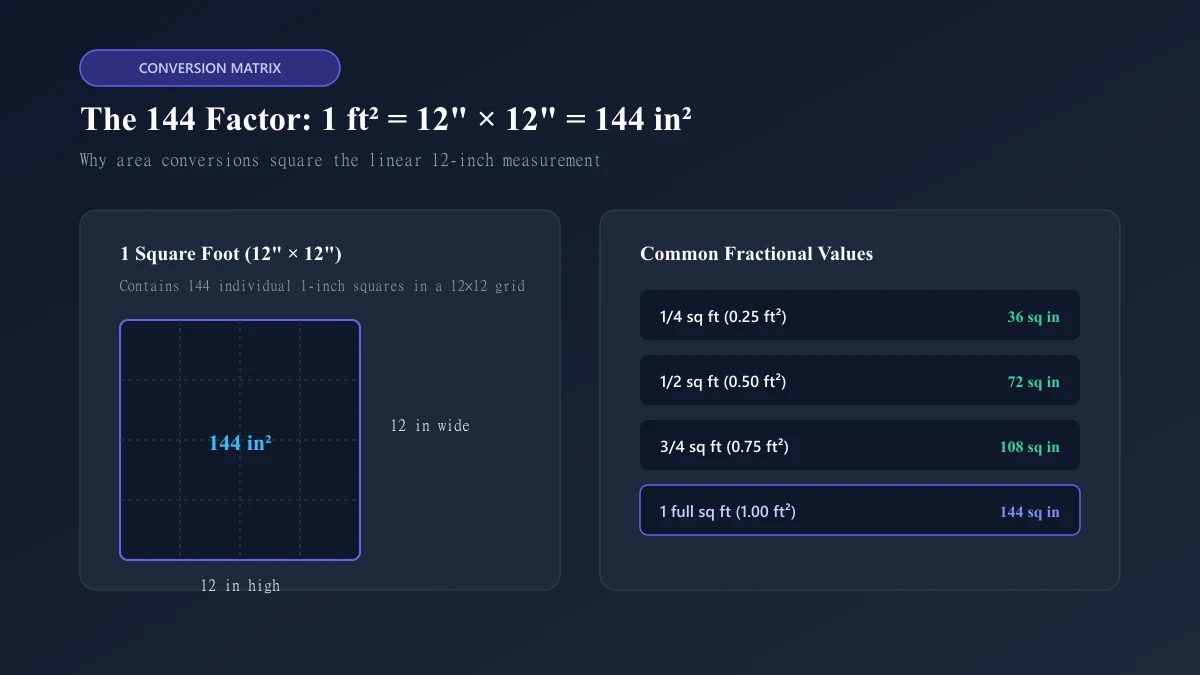
The detail that trips people up is the word “square.” One foot equals 12 inches, but one square foot contains a 12-by-12 grid of square inches. Using 12 instead of 144 produces a result that is twelve times too small.
This conversion is useful when a material’s coverage is listed in square feet while individual pieces are measured in inches. It also helps with craft layouts, tile calculations, and drawing measurements. The arithmetic stays simple once you separate an existing area from the dimensions used to calculate it. The examples below cover both, including fractions, mixed measurements, and sensible rounding.
Quick Answer: Multiply the Area by 144
To convert square feet to square inches, multiply the square-foot value by 144. The relationship is exact: 1 ft² = 144 in². For example, 7.5 ft² equals 1,080 in². To reverse the conversion, divide square inches by 144. Both units measure area, so no depth measurement is needed.
Where the 144 Conversion Factor Comes From
A square foot is the area of a square with sides one foot long. Since each side is 12 inches, its area in inches is:
The conversion factor is 12² because area is a two-dimensional measurement. Both length and width change units. NIST’s measurement tables confirm the exact relationship of one square foot to 144 square inches.
You can picture twelve rows, each containing twelve one-inch squares. That grid explains how many square inches are in one square foot without relying on a memorized rule.
The surface area itself does not grow during unit conversion. The numerical value grows because you are counting smaller units.
Nor does an area of one square foot require a square-shaped object. A rectangle measuring 6 inches by 24 inches also has an area of 144 in², or 1 ft². Unit names describe how area is measured, not the outline of the object.
The Sq Ft to Sq In Formula and Calculator Method
Use this square foot to square inch conversion formula:
Here, Aᵢ is area in square inches and A𝒻 is area in square feet.
Suppose a piece of fabric has a stated area of 8.75 ft²:
An area converter should produce that same result when its input unit is ft² and its output unit is in². Enter the existing area, rather than one side length or a pair of dimensions. If the tool has separate length and width boxes, it is calculating area before converting it.
The units can also be written into the calculation:
The ft² units cancel, leaving in². This check is called dimensional analysis. It helps you see whether the calculation ends in the unit you actually want.
For a quick verification, divide the result by 144. Here, 1,260 ÷ 144 returns the original 8.75 ft².
Conversion Chart for Whole and Partial Square Feet
This table includes smaller areas as well as whole-number square footage. Every entry uses the same exact multiplier.
| Square feet (ft²) | Square inches (in²) |
|---|---|
| 0.01 | 1.44 |
| 0.125 | 18 |
| 0.25 | 36 |
| 0.5 | 72 |
| 0.75 | 108 |
| 1 | 144 |
| 1.5 | 216 |
| 2.5 | 360 |
| 4 | 576 |
| 6.25 | 900 |
| 10 | 1,440 |
| 12.5 | 1,800 |
| 25 | 3,600 |
| 40 | 5,760 |
| 100 | 14,400 |
A value below one square foot can still contain many square inches. For example, 0.125 ft² is one-eighth of a square foot, so its equivalent is 144 ÷ 8, or 18 in².
Decimals in the output are also valid. An area does not need to contain a whole number of one-inch squares.
When You Have Length and Width Instead of Area
A conversion starts with an area. If you have only dimensions, calculate the area first.
For a rectangle, area = length × width. Use matching length units before multiplying.
Dimensions Already Measured in Feet
Consider a rectangular display board measuring 2.75 feet by 1.5 feet:
You could also convert both sides first. They become 33 inches and 18 inches, giving 33 × 18 = 594 in². Either route works, provided both dimensions use the same unit.
Feet-and-Inches Measurements
For a panel measuring 3 feet 7 inches by 1 foot 9 inches, convert the dimensions to inches:
- Length: 3 × 12 + 7 = 43 inches.
- Width: 1 × 12 + 9 = 21 inches.
The corresponding square footage is 903 ÷ 144, or approximately 6.2708 ft².
Writing 3 feet 7 inches as 3.7 feet would be incorrect. Decimal feet use fractions of a whole foot, while inches divide a foot into twelve parts.
If you have mixed units, with one side in feet and the other in inches, convert one side to match the other. A 2-foot-by-15-inch rectangle becomes 24 × 15 = 360 in². Multiplying 2 by 15 and labeling the result square feet would mix units.
Work With Fractions Without Losing Accuracy
Fractions of a square foot can often be converted directly, without a decimal approximation.
To convert half a square foot to square inches:
For a mixed number such as 3⅝ ft², calculate the whole and fractional parts separately:
This approach avoids entering a fraction incorrectly into a calculator. If the tool accepts only decimals, 3⅝ becomes 3.625, producing the same 522 in².
Be more careful with repeating decimals. Two-thirds of a square foot equals exactly 96 in² because 144 × 2 ÷ 3 = 96. Entering 0.67 instead produces 96.48 in².
That difference comes from rounding the input, not from the conversion factor. Keep a fraction exact when possible, especially if the result will be used in another calculation.
Convert Circular, Triangular, and Cutout Areas
The multiplier does not change with shape. What changes is the formula used to find the starting area. Standard geometry formulas use πr² for a circle and half the base times perpendicular height for a triangle.
Circular Surface
Suppose a circular tabletop has a diameter of 2.5 feet. Its radius is half that amount, or 1.25 feet:
That is approximately 706.86 in². Keeping π until the final step avoids unnecessary intermediate rounding. Using the diameter as the radius would make the result four times too large.
Triangular Piece
A triangular insert with a 2.4-foot base and a perpendicular height of 1.25 feet has an area of:
The perpendicular height is the distance measured at a right angle to the base. A sloping side is not automatically the height.
Surface With an Opening
For a 5 ft² panel containing an opening of 36 in², convert the larger area before subtracting:
Net area means the surface remaining after the opening is removed. Subtracting 36 directly from 5 would combine unlike units and produce a meaningless answer.
Use Converted Area to Estimate Tile or Piece Counts
Converting area is helpful when the target surface and individual pieces are described in different units.
Imagine a decorative surface measuring 11.25 ft² and rectangular pieces with actual dimensions of 9 inches by 6 inches. Assume those dimensions represent the coverage face and that there are no gaps or overlaps for this initial estimate.
Thirty pieces supply the same total face area as the surface. That calculation does not prove that thirty pieces will fit the layout. Edges, cuts, pattern direction, and unusable offcuts can affect the actual quantity.
Tile coverage with grout joints also differs from the combined area of tile faces alone. Use the intended layout or the manufacturer’s coverage information when spacing matters.
If your project calls for a specific waste allowance, apply it separately and identify the assumption. An example allowance of 8% would give 30 × 1.08 = 32.4 pieces, rounded up to 33 whole pieces. That percentage is illustrative, not a rule for every job.
Keep Material Rates Consistent With the Area Unit
A price per square foot and a price per square inch can describe the same rate, but the numerical values differ.
Suppose a supplier quotes a hypothetical rate of $7.20 per square foot:
For a piece measuring 450 in², either unit gives the same area-based charge:
Or first convert the area:
The rate conversion runs in the opposite numerical direction from the area conversion. Area is multiplied by 144 when moving to square inches; a rate per square foot is divided by 144 to become a rate per square inch.
Check the wording beside the quoted price. A rate per linear foot, per sheet, or per piece cannot be treated as a rate per square foot without more information.
These examples calculate only the area-based charge. Minimum order sizes, cutting fees, and package quantities can make a supplier’s final price different.
Measurement Precision and Rounding the Result
The factor 144 is exact. The measurement you enter may still be an estimate.
If a measured area is 2.83 ft², the arithmetic gives 407.52 in². That result is the exact conversion of the entered number; it does not establish that the original surface was measured perfectly.
Avoid rounding an intermediate area before converting it. For instance, dimensions of 1.23 feet by 0.87 feet give:
Rounding the area to 1.07 ft² first would give 154.08 in². The difference is small here, but keeping the original values costs nothing and prevents accumulated rounding errors.
Report the final result to suit the measurement precision and purpose. Significant figures indicate how much meaningful precision a reported number carries. A calculator’s long decimal display does not make a rough measurement more precise.
If a converter displays 143.9997 in² for one square foot, it may be using rounded intermediate factors. The standard relationship is exactly 144. A direct multiplication avoids that unnecessary detour.
Frequently Asked Questions
Why Do I Multiply by 144 Instead of 12?
Twelve converts a length in feet to a length in inches. Area includes two dimensions, so both receive that factor: 12 × 12 = 144. Multiplying an existing square-foot area by only 12 converts just one dimension’s factor and leaves the result twelve times smaller than it should be.
Is 0.5 Square Foot the Same as a Square With Half-Foot Sides?
No. A square with sides of 0.5 foot has an area of 0.5 × 0.5 = 0.25 ft², equivalent to 36 in². An area of 0.5 ft² equals 72 in². Halving both sides of a square reduces its area to one-quarter of the original, not one-half.
How Do I Convert Square Inches to Square Feet?
Divide the square-inch area by 144. For example, 864 in² ÷ 144 = 6 ft². The physical surface remains the same, but the numerical value gets smaller because square feet are larger units. Use division by 144 rather than a shortened decimal reciprocal when you want to avoid extra rounding.
Can I Convert Square Feet Into Inches?
Square feet convert directly to square inches, which measure area. Ordinary inches measure length, so there is no single length answer. To find a rectangle’s length, you also need its width. An area of 2 ft² could describe a 12-by-24-inch rectangle or an 8-by-36-inch rectangle.
What Is the Formula for Square Feet to Square Inches in Excel?
If cell A2 contains an area in square feet, enter =A2*144 in the result cell. For multiple rows, copy that formula down so each row references its own input. Alternatively, Excel supports =CONVERT(A2,“ft2”,“in2”). Label the columns clearly and keep units outside the numeric input cells.
Do I Multiply by 144 Twice for Length and Width?
No. Multiply an existing square-foot area by 144 once. If you start with dimensions in feet, convert each side to inches by multiplying each by 12, then multiply those sides together. Applying 144 to both side lengths would confuse a length conversion with an area conversion and greatly overstate the answer.
Can This Conversion Give the Volume of a Sheet?
It gives area only. To calculate volume, you also need thickness. For example, a 2 ft² sheet has a face area of 288 in². At a uniform thickness of 0.25 inch, its volume is 288 × 0.25 = 72 in³. Square inches and cubic inches describe different quantities.
Match the Multiplier to the Measurement
For sq ft to sq in, use an existing area and multiply once by 144. If you have dimensions, calculate the area with consistent units first. Keep fractional inputs and intermediate results unrounded where practical. Then use the converted area for the task at hand, with layout allowances or purchase rounding shown separately.
Related Topics
Written by BigTechies Editorial Team
BigTechies develops accurate, practical calculation and unit conversion tools for contractors, designers, architects, and DIY homeowners. Every formula and reference guide is reviewed for dimensional consistency and mathematical precision.
Related Articles
Continue exploring practical measurement guides
 Volume & Area
How Many Sq Feet in a Cubic Foot? Coverage Depends on Depth
Find how many square feet one cubic foot covers at different depths. See a clear coverage chart, bag examples, and why area and volume have no fixed conversion.
 Unit Conversion
Converter Meter to Square Feet: Get the Right Area Conversion
Convert square meters to square feet with accurate formulas and examples. Learn when meter measurements need a width, plus tables, room calculations, and tips.
 Volume & Area
How Do I Find the Cubic Feet? A Practical Measuring Guide
Learn how to find cubic feet from feet, inches, or metric measurements. Get clear examples for boxes, rooms, cylinders, and spaces with uneven dimensions.
Calculate Your Project in Seconds
Whether you're pouring concrete, spreading garden mulch, or estimating freight container volume, our instant calculator provides exact answers with zero guesswork.