
140 Cubic Feet Visualized: Dimensions, Boxes, and Storage Comparisons
See 140 cubic feet visualized with clear dimensions, moving-box comparisons, and storage examples. Learn what the volume means and why packing space varies.
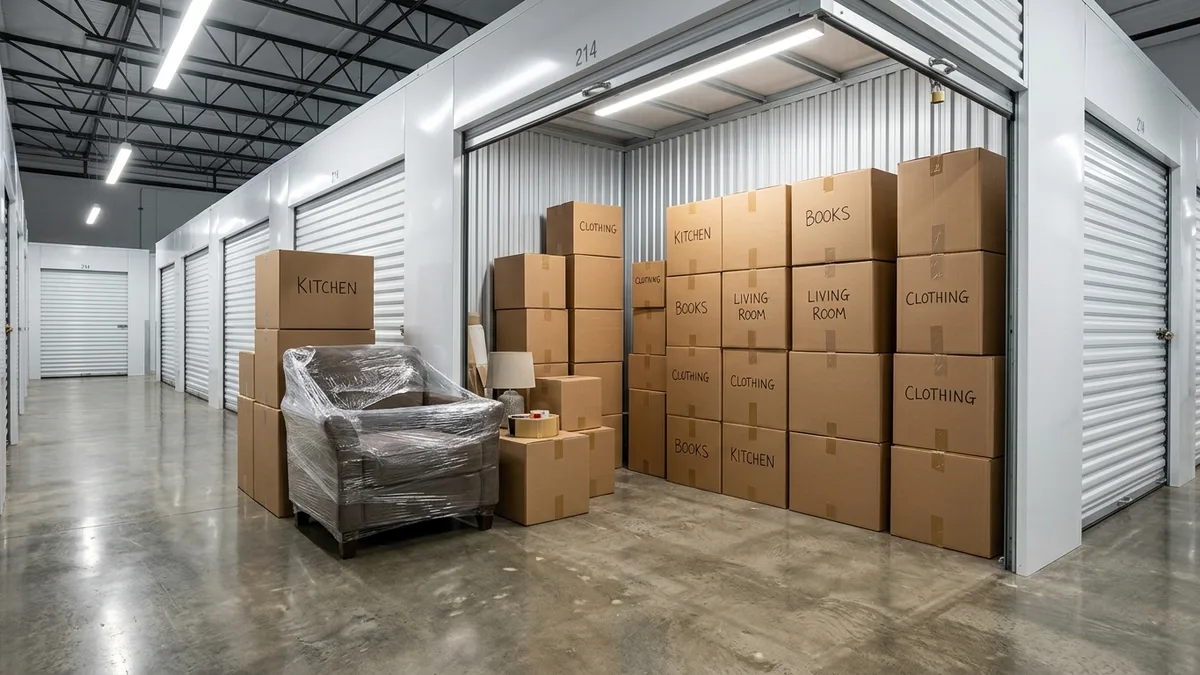
Clean modern self-storage unit with organized stacks of moving boxes and furniture
Table of Contents (19 sections) ▼
- 140 Cubic Feet Visualized: Quick Size Reference
- How Big Is 140 Cubic Feet in Different Shapes?
- What Does 140 Cubic Feet Look Like in a Room?
- What Is the Side Length of a 140-Cubic-Foot Cube?
- Compare the Volume With a Small Cargo Trailer
- How Many Moving Boxes Equal 140 Cubic Feet?
- Why the physical box count can be lower
- Floor Footprint Changes With Stack Height
- What Can Fit in 140 Cubic Feet of Storage?
- Check the Load Before Choosing a Container
- Express 140 Cubic Feet in Other Volume Units
- Common Questions About This Size
- Is 140 cubic feet the same as 140 square feet?
- Is 140 cubic feet enough for a studio apartment move?
- Can a sofa fit in a 140-cubic-foot space?
- Does 140 cubic feet have a fixed weight?
- Are 47 three-cubic-foot boxes exactly 140 cubic feet?
- What is the easiest way to picture this volume at home?
- Match the Picture to the Space You Need
For 140 cubic feet visualized, picture a block 7 feet long, 5 feet wide, and 4 feet high. That space contains exactly 140 cubic feet. If you prefer a cube, imagine one measuring approximately 5.19 feet along each edge. These are two different shapes with the same volume.
This measurement often appears in moving estimates, storage descriptions, and cargo specifications. It tells you how much three-dimensional space is available, but it does not tell you the shape of that space or whether a particular piece of furniture will fit.
The most useful approach is to connect the number to dimensions you can mark out, then check it against your actual belongings. The comparisons below show the size as blocks, box volumes, floor footprints, and a real cargo reference. They also explain why a space rated at 140 cubic feet may hold less than a simple volume calculation suggests.
140 Cubic Feet Visualized: Quick Size Reference
140 cubic feet is the volume of a rectangular block measuring 7 × 5 × 4 feet. An equal-volume cube has sides about 5.19 feet long. The volume is also approximately 3.96 cubic meters. Actual storage fit depends on the space’s dimensions, access opening, and arrangement of the contents.
| Reference | What to picture |
|---|---|
| Length | 7 feet along the floor |
| Width | 5 feet across the floor |
| Height | 4 feet above that footprint |
| Floor footprint | 35 square feet |
| Enclosed volume | 140 cubic feet |
Think of this as an imaginary boundary around a pile, not a claim that any particular room or container has these dimensions.
How Big Is 140 Cubic Feet in Different Shapes?
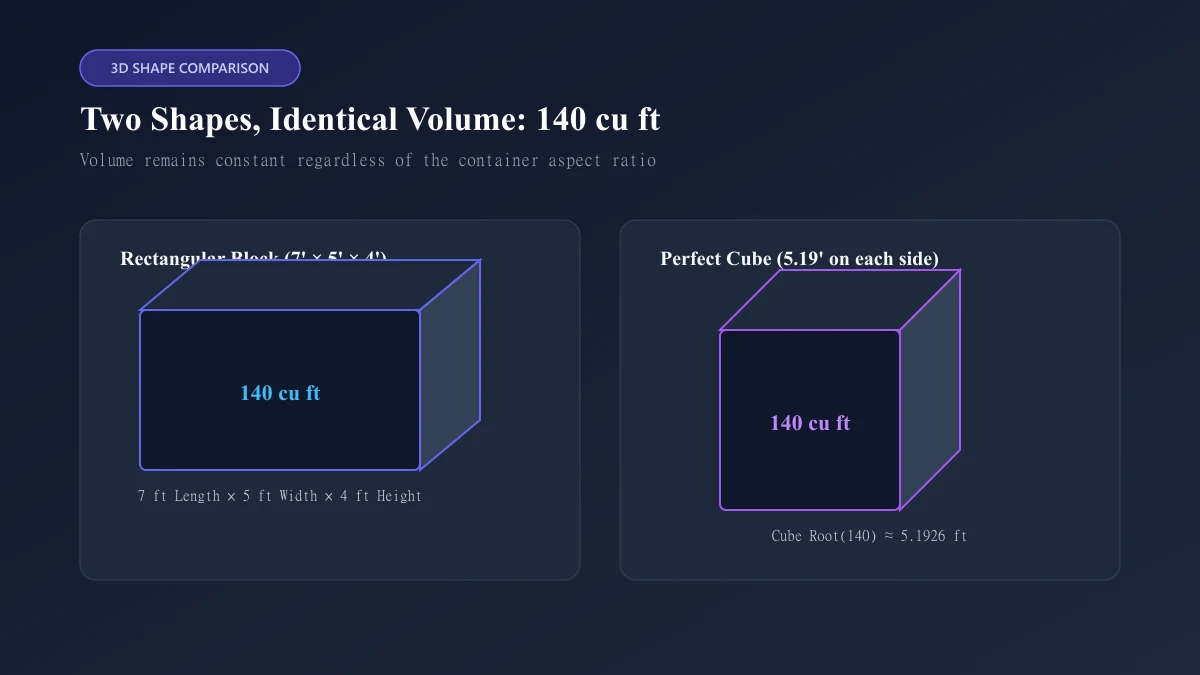
A cubic foot is the volume inside a cube with one-foot edges. You could picture 140 such cubes arranged into a larger block, although real storage spaces rarely consist of neat individual compartments.
For a rectangular prism, a box-shaped solid, use:
All three measurements must be in feet to get a result in cubic feet.
Here are three possible sets of 140 cubic feet dimensions:
| Length | Width | Height | Volume | Shape impression |
|---|---|---|---|---|
| 7 ft | 5 ft | 4 ft | 140 ft³ | A broad block at a moderate height |
| 10 ft | 7 ft | 2 ft | 140 ft³ | A long, low layer |
| 5 ft | 4 ft | 7 ft | 140 ft³ | A narrower, taller block |
These shapes provide equal storage capacity by volume, but their contents could differ. A rigid 8-foot pole can lie along the length of the 10-foot block. It cannot lie along the 7-foot length of the first block without changing its orientation.
The lesson is practical: volume describes the total space, while length, width, and height determine how that space is arranged.
What Does 140 Cubic Feet Look Like in a Room?
You can make the measurement easier to understand using painter’s tape and a tape measure.
Mark a rectangle 7 feet long and 5 feet wide on the floor. Then identify a point 4 feet above floor level on a nearby wall. Imagine extending the entire taped rectangle upward to that height.
This gives you a physical reference for the volume without needing a container. Keep the imagined sides vertical; a loosely piled heap that narrows toward its top does not fill the whole block.
For a different view, mark a 5-by-4-foot footprint and imagine it extending 7 feet upward. The volume remains 140 cu ft, but it occupies less floor space and requires much taller stacking.
Neither example means that 140 cubic feet equals a full room. Room sizes vary, and this visualization describes only a measured section of space.
Also remember that a tall boundary is easier to imagine than to fill. Shelves, box strength, access needs, and the items’ ability to support weight can limit the usable stack height.
What Is the Side Length of a 140-Cubic-Foot Cube?
A cube has equal length, width, and height. To find the side of a cube with a known volume, take the cube root:
That is approximately 5 feet 2.3 inches along each edge.
The cube is a useful volume visualization because you only need to remember one dimension. Picture a floor square a little more than 5 feet across, extending upward by the same distance.
The rounded figure of 5.19 feet is close enough for a mental comparison. It is not an exact construction measurement: cubing a rounded side length produces a volume slightly different from 140.
Do not divide 140 by three to find a cube’s side. Volume comes from multiplying the three dimensions. Taking the cube root reverses that multiplication when all three are equal.
Compare the Volume With a Small Cargo Trailer
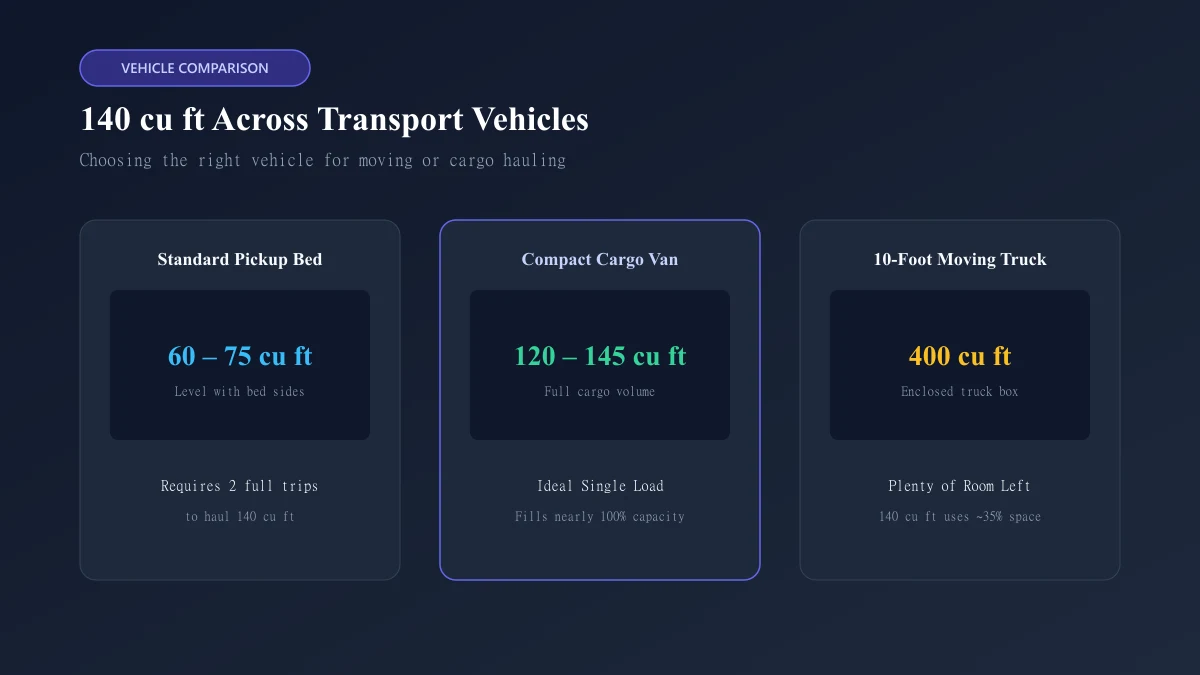
For a real-world reference, U-Haul lists its 4×8 cargo trailer at 142 cubic feet of cargo capacity. That is close to 140 cubic feet, with a difference of 2 cubic feet.
This makes the enclosed trailer a useful comparison if you have seen one parked or loaded. It suggests the overall scale of the volume more clearly than an abstract number alone.
However, the trailer is a near-volume reference, not an exact model of the 7-by-5-by-4-foot block. Its shape, internal dimensions, and door opening determine what can pass inside and where it can be placed.
Do not interpret the “4×8” name as a full set of precise internal measurements. Check the supplier’s actual specifications for the equipment you plan to use.
Cargo capacity also differs from payload. Capacity describes space; payload describes the allowed cargo weight. A dense load may reach its weight limit while much of the interior space remains empty.
For moving plans, use the comparison to understand size, then check the actual equipment and your inventory separately.
How Many Moving Boxes Equal 140 Cubic Feet?
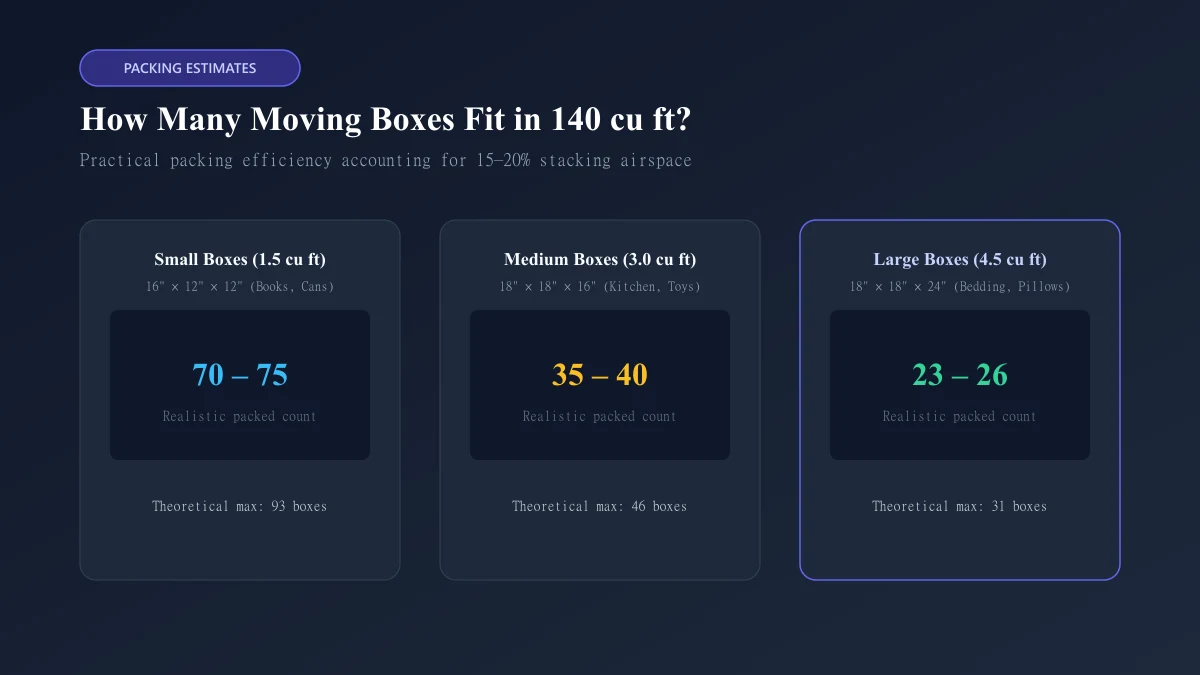
The answer depends on the moving box volume. As a nominal comparison, a box rated at 3 cubic feet gives:
140 ÷ 3 ≈ 46.67 box volumes
U-Haul lists its medium moving box as 3 cubic feet. Using that stated size, 46 boxes represent 138 cubic feet of nominal capacity, while 47 represent 141 cubic feet.
Other assumed box sizes change the comparison:
| Nominal volume per box | Box volumes equivalent to 140 ft³ |
|---|---|
| 2 ft³ | 70 |
| 3 ft³ | Approximately 46.67 |
| 4 ft³ | 35 |
| 5 ft³ | 28 |
This table explains equivalent volume. It does not guarantee that those whole boxes fit inside a particular 140-cubic-foot container.
Why the physical box count can be lower
Nominal capacity may describe the space inside a box. For loading, its external dimensions matter because cardboard thickness and any bulging also occupy room.
Packing gaps create another difference. Rows of boxes may leave unused strips along the walls or below the ceiling. Mixed box sizes, fragile contents, and boxes that cannot safely support another layer complicate the arrangement.
Treat the box comparison as a scale reference. To predict a load, measure the closed boxes and map their placement within the available dimensions.
Floor Footprint Changes With Stack Height
140 cubic feet of storage does not have one fixed floor area. For a uniform rectangular space, divide volume by height:
| Assumed height | Floor area needed | One possible footprint |
|---|---|---|
| 2 ft | 70 ft² | 10 × 7 ft |
| 4 ft | 35 ft² | 7 × 5 ft |
| 5 ft | 28 ft² | 7 × 4 ft |
| 7 ft | 20 ft² | 5 × 4 ft |
| 8 ft | 17.5 ft² | 5 × 3.5 ft |
The table assumes the full footprint can be filled evenly to the stated height. It does not include an aisle or unusable space above irregular items.
If you need access to stored belongings, a tightly filled block may be unsuitable. A walkway, shelves, or space to remove boxes can increase the footprint needed for the same inventory.
Use the actual safe stacking height of your belongings rather than automatically using the ceiling height. Otherwise, the calculated footprint may be smaller than your practical requirement.
What Can Fit in 140 Cubic Feet of Storage?
There is no reliable furniture list that applies to every 140-cubic-foot space. Two loads with equal item volume can require different amounts of packed volume.
A set of square cartons may arrange neatly. Chairs with projecting legs, a curved sofa, and a bicycle can leave gaps that are difficult to use.
You can make an initial estimate with a measured inventory. For example, consider these hypothetical external bounding dimensions:
| Packed item | Assumed dimensions | Bounding volume |
|---|---|---|
| 12 cartons | Each 2 × 1.5 × 1 ft | 36 ft³ total |
| One packed cabinet | 3 × 2 × 4 ft | 24 ft³ |
| One protected tabletop | 5 × 3 × 0.5 ft | 7.5 ft³ |
| Total | Before arrangement gaps | 67.5 ft³ |
A bounding volume is the rectangular space around an item. It helps with planning but does not describe the exact volume of the object’s material.
The total is below 140 cubic feet, yet that alone cannot prove the load fits. You still need a workable arrangement, a suitable door opening, and room for any additional packaging.
Disassembled furniture may reduce the required bounding space, but measure it in the form you will actually transport.
Check the Load Before Choosing a Container
A cubic feet storage calculator can help total an inventory. To make its result useful, gather measurements consistently.
- Measure packed items. Include covers, cartons, padding, and projecting parts.
- Record usable container dimensions. Internal measurements determine the available space.
- Check entry clearance. Compare large items with the door and any restricted passage.
- Plan the layout. Consider which items can rotate, nest, or safely stack.
- Check cargo weight separately. Volume calculations cannot establish compliance with a weight limit.
Be careful about double counting. If a cabinet contains packed belongings during transport, counting both its full bounding volume and every item’s separate bounding volume can exaggerate the total. Weight still includes everything inside it.
Conversely, do not assume every hollow space is usable. It may be inaccessible, fragile, or unsuitable for the items you want to place there.
There is no universal packing-efficiency percentage that predicts every load. A dimensioned layout is more useful than subtracting an arbitrary fraction from the advertised volume.
Express 140 Cubic Feet in Other Volume Units
Metric equivalents can help when a moving quote or container specification uses different units.
| Unit | Equivalent to 140 ft³ |
|---|---|
| Cubic meters | Approximately 3.96436 m³ |
| Liters | Approximately 3,964.36 L |
| Cubic yards | Approximately 5.18519 yd³ |
| US liquid gallons | Approximately 1,047.27 US gal |
| Cubic inches | Exactly 241,920 in³ |
For everyday comparison, about 3.96 cubic meters is usually a manageable figure. Keep more precision when checking a quotation or performing another calculation.
The gallon value uses US gallons. Imperial gallons are different, so the label matters.
These conversions describe equivalent volume, not how much water a trailer can carry or how much its contents weigh. A weight estimate needs information about the material, and actual transport remains subject to equipment limits.
Common Questions About This Size
Is 140 cubic feet the same as 140 square feet?
No. Cubic feet measure volume, while square feet measure area. A 140-cubic-foot block that is 4 feet high occupies 35 square feet. At 7 feet high, it occupies 20 square feet. You must know or assume the height before connecting a volume to a floor-area measurement.
Is 140 cubic feet enough for a studio apartment move?
It depends on the inventory, furniture dimensions, packaging, and loading arrangement. The apartment’s floor area does not establish the volume of its contents. Measure the items you are taking, include their packed dimensions, and check the container’s access opening before relying on a capacity figure alone.
Can a sofa fit in a 140-cubic-foot space?
Possibly, but total volume is insufficient to answer. Measure the sofa’s protected external dimensions and check the container’s internal dimensions, door opening, and turning clearance. A long sofa can be too large in one direction even when its bounding volume is far below the container’s listed capacity.
Does 140 cubic feet have a fixed weight?
No. The same volume can contain air, clothing, books, gravel, or other materials with very different weights. For a weight calculation, you need a suitable density or measured item weights. When planning transport, compare the total loaded weight with the equipment’s applicable cargo limit separately.
Are 47 three-cubic-foot boxes exactly 140 cubic feet?
No. Their combined nominal capacity is 141 cubic feet because 47 × 3 = 141. Forty-six such boxes total 138 cubic feet. Neither number guarantees physical fit: the boxes’ external size, packing gaps, stacking limits, and the shape of the container still affect the actual loading arrangement.
What is the easiest way to picture this volume at home?
Mark a 7-by-5-foot rectangle on the floor and imagine its boundaries extending vertically to 4 feet. That gives an exact 140-cubic-foot rectangular volume. If the floor space is unavailable, use a 5-by-4-foot footprint with an imagined 7-foot height for the same total volume.
Match the Picture to the Space You Need
With 140 cubic feet visualized as a 7 × 5 × 4-foot block, you have a clear starting reference. The cube, trailer, and box comparisons offer other ways to understand its scale.
For a real storage or moving decision, measure the packed belongings and check the usable dimensions. Volume tells you how much space exists; shape, access, and arrangement determine whether that space works for your load.
Related Topics
Written by BigTechies Editorial Team
BigTechies develops accurate, practical calculation and unit conversion tools for contractors, designers, architects, and DIY homeowners. Every formula and reference guide is reviewed for dimensional consistency and mathematical precision.
Related Articles
Continue exploring practical measurement guides
 Volume & Area
How Many Sq Feet in a Cubic Foot? Coverage Depends on Depth
Find how many square feet one cubic foot covers at different depths. See a clear coverage chart, bag examples, and why area and volume have no fixed conversion.
 Unit Conversion
Converter Meter to Square Feet: Get the Right Area Conversion
Convert square meters to square feet with accurate formulas and examples. Learn when meter measurements need a width, plus tables, room calculations, and tips.
 Volume & Area
How Do I Find the Cubic Feet? A Practical Measuring Guide
Learn how to find cubic feet from feet, inches, or metric measurements. Get clear examples for boxes, rooms, cylinders, and spaces with uneven dimensions.
Calculate Your Project in Seconds
Whether you're pouring concrete, spreading garden mulch, or estimating freight container volume, our instant calculator provides exact answers with zero guesswork.