
Cubic Feet to Square Feet: Calculate Coverage From Volume and Depth
Convert cubic feet to square feet using a known depth or height. Follow clear formulas, compare coverage by thickness, and plan soil, mulch, or concrete use.
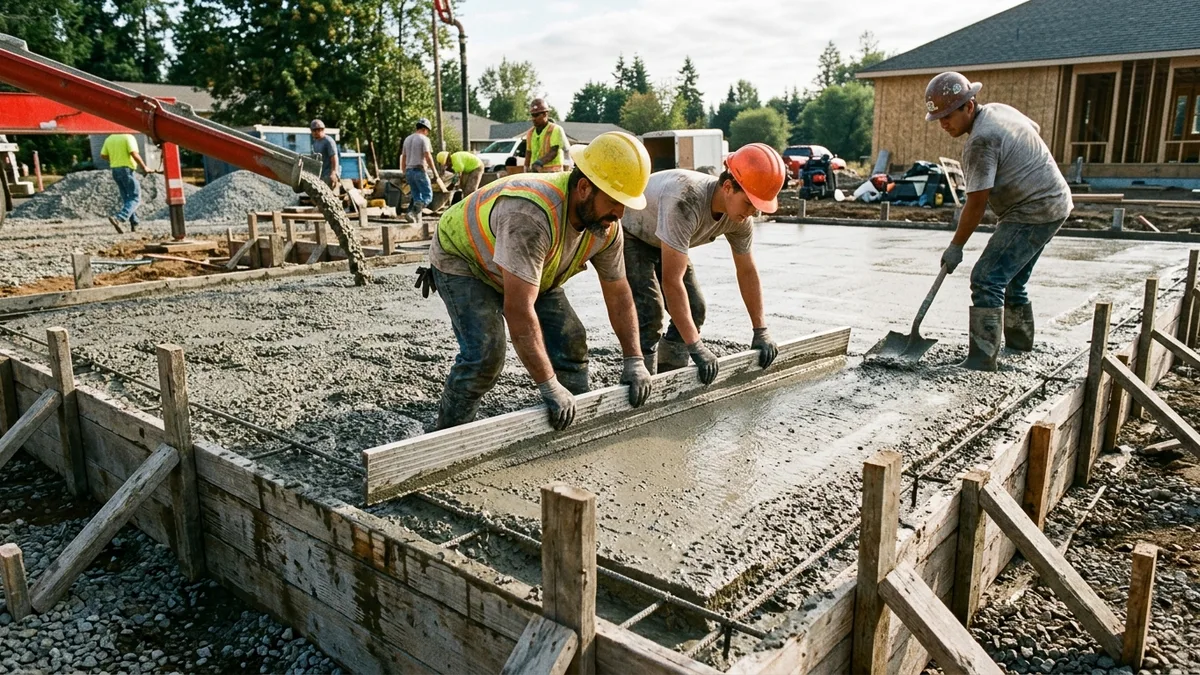
Construction workers leveling freshly poured concrete in timber foundation forms with an aluminum screed board
Table of Contents (27 sections) ▼
- Quick Answer: Divide Available Volume by Depth
- What Area Are You Actually Trying to Find?
- Use a Cubic Feet to Square Feet Calculator Correctly
- Work With Depth in Feet, Inches, or Mixed Measurements
- Depth measured in feet
- Depth measured in inches
- A depth stated in feet and inches
- Find Your Available Supply Before Estimating Coverage
- Add volumes from bagged material
- Convert bulk volume stated in cubic yards
- Check concrete product yield
- Coverage Examples for Different Projects
- Topsoil: Find a practical strip width
- Compost: Understand a thinner application
- Gravel: Use volume in the relevant condition
- Concrete: Check a fixed yield against a slab footprint
- Compare Coverage at Different Layer Thicknesses
- Allocate One Supply Across Several Areas
- Distinguish Calculated Coverage From Real Coverage
- Questions About Volume-Based Area Calculations
- Can you find area without knowing depth or height?
- How many square feet does a cubic foot cover?
- How many square feet does 2 cubic feet of mulch cover?
- How does increasing depth change mulch coverage?
- How do you calculate floor area from room volume and height?
- Is storage stacking height the same as ceiling height?
- Attach the Depth to Every Coverage Answer
To convert cubic feet to square feet, divide the volume by the depth or height in feet. If the depth is in inches, multiply the volume by 12, then divide by the inch measurement. For example, 18 cubic feet spread 4.5 inches deep covers 48 square feet.
This calculation is useful when you already have material and want to know how far it will go. Bags of mulch, a pile of topsoil, or a measured concrete yield all describe volume. Your garden bed, path, or slab footprint describes area. The intended thickness connects the two.
There is no single answer without that thickness. A fixed supply covers more ground in a thin layer and less ground in a deep one. The guide below shows how to choose the inputs, compare coverage, and divide available material across areas without assuming it will stretch farther than it can.
Quick Answer: Divide Available Volume by Depth
Find coverage area by dividing volume in cubic feet by a uniform depth in feet. For depth measured in inches, use area = volume × 12 ÷ depth. The answer is in square feet and assumes even distribution without a change in material volume during placement.
For a room with constant height, the same relationship gives floor area when you divide enclosed volume by height in feet.
What Area Are You Actually Trying to Find?
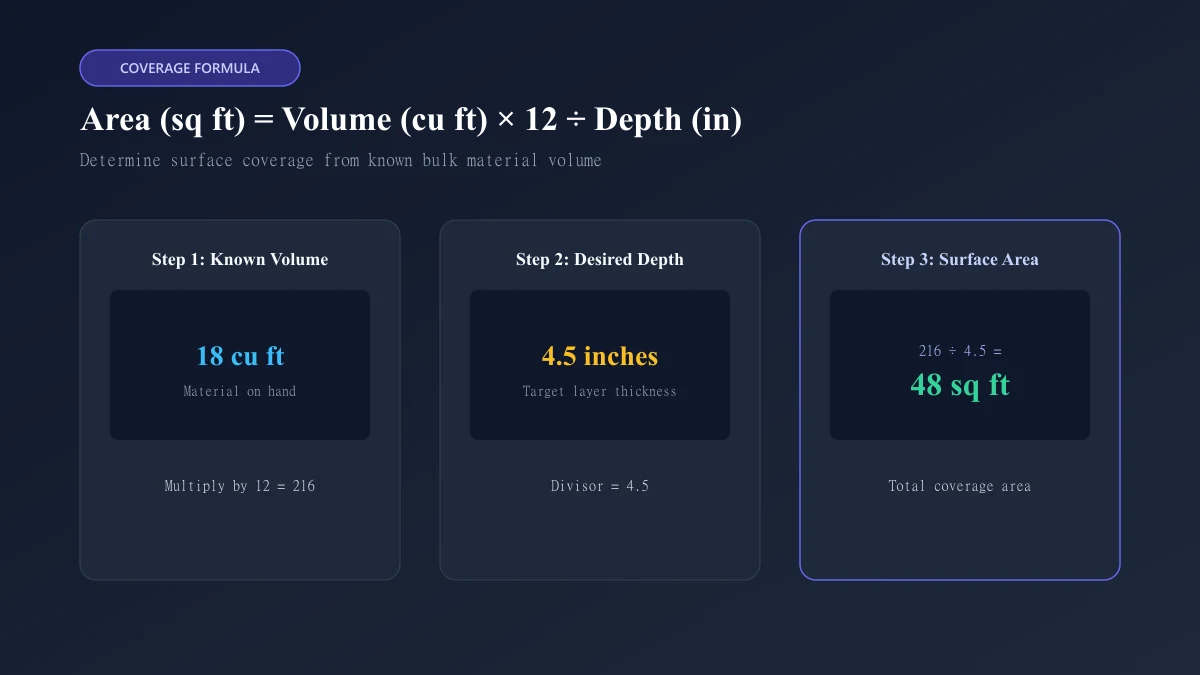
Before calculating, decide what the result should represent. For landscaping, it is usually the ground covered by a material layer. For a room, it may be the floor footprint below an enclosed volume.
Neither result is the total surface area of an object. Dividing a box’s volume by its height gives its base area, not the combined area of its walls, top, and bottom.
The formula comes from a simple relationship:
If volume is known, dividing by the third dimension leaves area. In unit terms:
This unit check, called dimensional analysis, helps you spot a mismatched measurement.
The relationship assumes a uniform depth or a shape with constant horizontal cross-section. A mound, tapered container, or room with a changing ceiling height needs a suitable geometry calculation or a justified average measurement.
Use a Cubic Feet to Square Feet Calculator Correctly
A volume to area calculator needs two pieces of information: available volume and the depth or height that volume will occupy.
Use this sequence:
- Enter the usable volume. Read the bag label, delivery quantity, or measured capacity.
- Enter the required depth. Use the additional layer you intend to place, not automatically the full bed depth.
- Select inches or feet. Check the unit beside the depth field.
- Calculate coverage. Read the answer as area, commonly written as ft² or sq ft.
- Check the assumption. Confirm that the layer can be distributed evenly at that thickness.
If you already have a finished volume figure, do not enter the original length, width, and height again unless the tool asks you to calculate volume first.
A cu ft to sq ft result should also identify its depth. “This supply covers 48 square feet at 4.5 inches deep” is useful. “This supply equals 48 square feet” leaves out the condition that makes the answer valid.
Work With Depth in Feet, Inches, or Mixed Measurements
You can use either of two equivalent formulas. Choose the one that matches how the depth was measured.
Depth measured in feet
Let A represent area, V represent volume, and d represent depth in feet:
If 45 cubic feet of material forms a layer 0.75 feet deep:
The denominator must be greater than zero for an ordinary physical coverage calculation. A zero depth does not give a defined result.
Depth measured in inches
Replace d with the inch depth divided by 12:
This simplifies to:
For 21 cubic feet spread 3.5 inches deep:
The multiplication by 12 handles the inch-to-foot relationship. Simply dividing 21 by 3.5 would underestimate coverage by a factor of 12.
A depth stated in feet and inches
Suppose an enclosed space is 2 feet 6 inches high. Convert it to 2.5 feet, because 6 inches is half a foot.
With a volume of 95 cubic feet:
Entering 2.6 feet would describe a different height. Keep decimal notation separate from feet-and-inches notation.
Find Your Available Supply Before Estimating Coverage
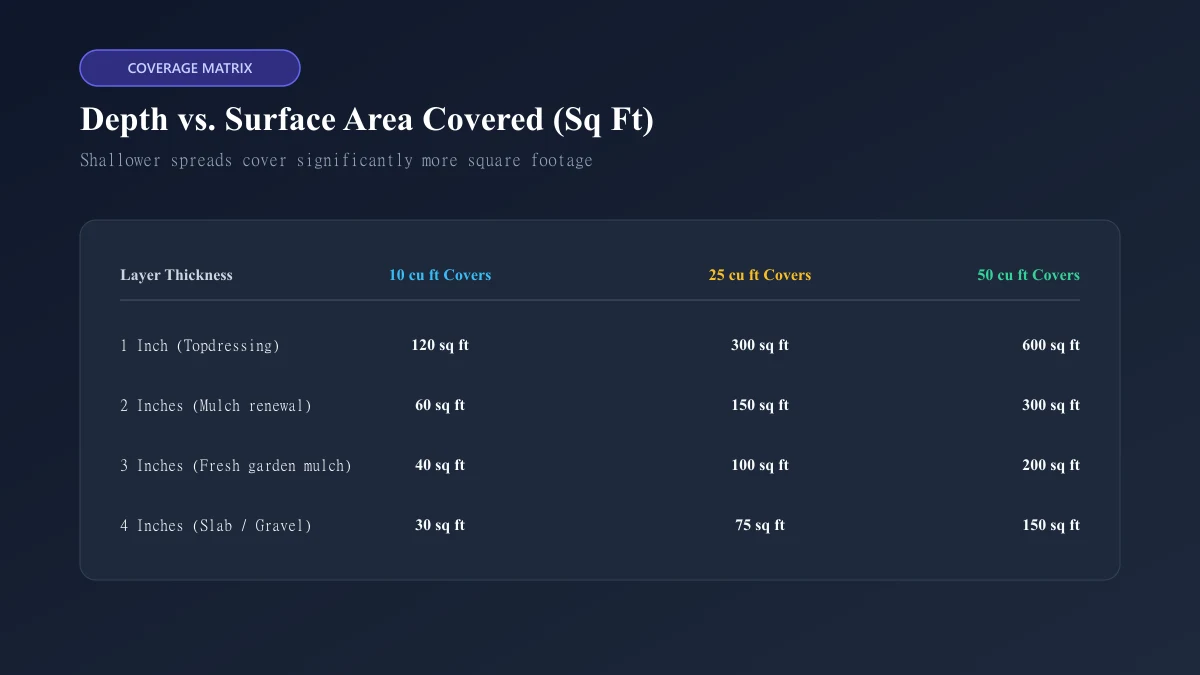
The calculation starts with usable volume. That may come from a bag count, bulk delivery, or product yield.
Add volumes from bagged material
Multiply the number of bags by the stated volume per bag. If you have 14 bags containing 1.5 cubic feet each:
At a chosen 3-inch depth, their geometric coverage is:
A mulch coverage calculator can combine those steps. For coverage per bag, use one bag’s volume rather than the combined supply.
Convert bulk volume stated in cubic yards
There are 27 cubic feet in one cubic yard. Multiply the delivery quantity by 27 before using a formula based on cubic feet.
For 0.8 cubic yards:
At 2 inches deep, that volume covers 129.6 square feet geometrically.
The equivalent shortcut for cubic yards to square feet is:
The factor 324 combines 27 cubic feet per cubic yard with 12 inches per foot.
Check concrete product yield
Dry bag weight is not finished volume. Use the manufacturer’s mixed concrete yield to determine the usable quantity.
If a selected product yields 0.50 cubic feet per bag and you have 24 bags, the calculated finished volume is 12 cubic feet. Use that figure with the specified slab thickness. Check the actual product label because yields vary.
Coverage Examples for Different Projects
These examples answer different planning questions. Their depths are illustrative assumptions, not recommended installation specifications.
Topsoil: Find a practical strip width
You have 16 cubic feet of topsoil and want a uniform 4-inch layer:
If the strip is 12 feet long, its calculated width is:
This connects topsoil coverage to a footprint you can mark out. A soil coverage calculator estimates the area; measurements determine whether the available supply matches your intended strip.
Compost: Understand a thinner application
Assume 7.5 cubic feet is available for compost spreading at half an inch deep:
A thin application covers a comparatively large area. Measure the layer carefully, since doubling it to 1 inch reduces the calculated coverage to 90 square feet.
Gravel: Use volume in the relevant condition
Suppose 54 cubic feet is available at the condition used in your coverage estimate. At a 4-inch depth:
If the supplied gravel is loose but the target layer must be compacted, the gravel coverage estimate needs product-specific adjustment. Loose volume and final compacted volume may differ.
Concrete: Check a fixed yield against a slab footprint
Using the 12-cubic-foot mixed yield above and an assumed specified thickness of 5 inches:
This is geometric concrete coverage for a uniform section. It excludes any deeper edges or footings and does not establish structural suitability.
Compare Coverage at Different Layer Thicknesses
The following table uses a fixed volume and changes only the depth. Values assume even distribution without settling or material loss.
| Layer thickness | 1 ft³ covers | 6 ft³ covers | 24 ft³ covers |
|---|---|---|---|
| 0.5 inch | 24 ft² | 144 ft² | 576 ft² |
| 1 inch | 12 ft² | 72 ft² | 288 ft² |
| 2 inches | 6 ft² | 36 ft² | 144 ft² |
| 3 inches | 4 ft² | 24 ft² | 96 ft² |
| 4 inches | 3 ft² | 18 ft² | 72 ft² |
| 6 inches | 2 ft² | 12 ft² | 48 ft² |
The table shows an inverse relationship: increasing depth reduces area for the same supply.
Use it to compare scenarios, not to select an installation depth. For a particular landscaping or building project, determine the appropriate thickness first. Reducing the depth solely to stretch a delivery may leave the finished layer unsuitable for its purpose.
Allocate One Supply Across Several Areas
A single total volume cannot determine one combined coverage figure when the areas need different depths. First decide how much material each planned section consumes.
Imagine that you have 30 cubic feet available. One section measures 36 square feet and needs a 5-inch layer:
That leaves another 15 cubic feet. If the second section needs a 2-inch layer:
The supply therefore serves 36 square feet at 5 inches and 90 square feet at 2 inches, assuming no adjustment or loss.
Do not average the two depth numbers and divide the entire supply by that average. The coverage depends on how the volume is allocated and how much area receives each thickness.
Record each section separately. This makes it easier to update the plan if one bed is enlarged or requires a deeper fill.
Distinguish Calculated Coverage From Real Coverage
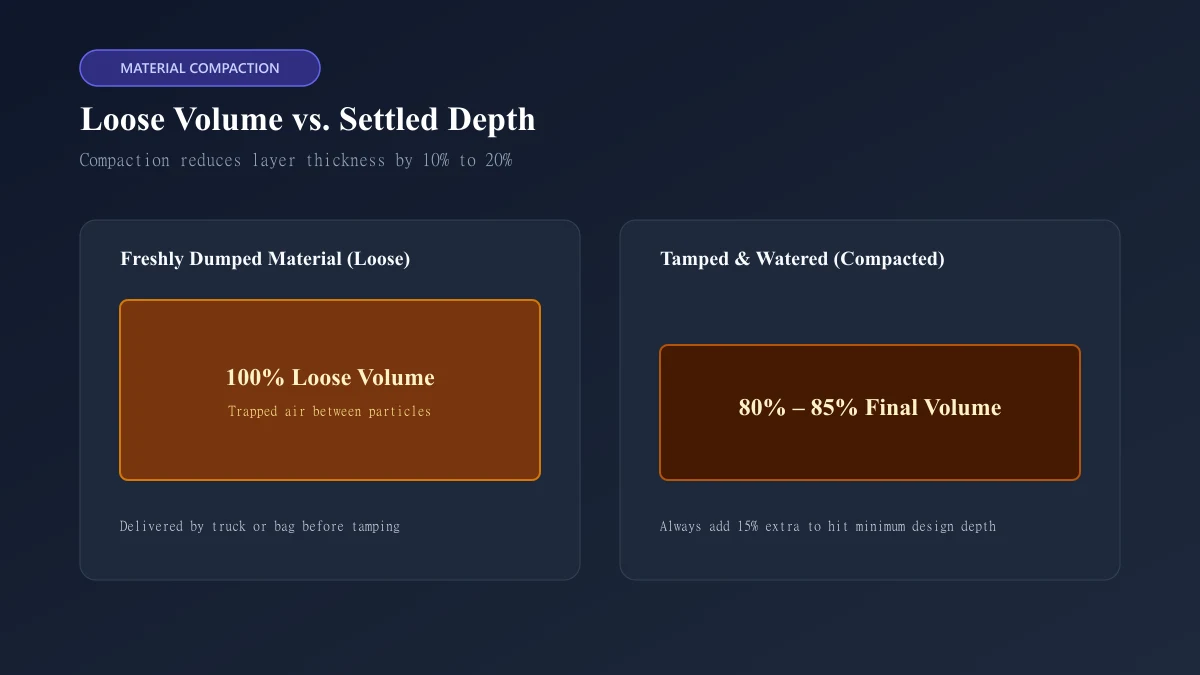
The formula produces a geometric area. Site conditions and material behavior affect whether the available supply creates the intended finished layer.
Settlement can reduce the height of a loose layer. Compaction may change aggregate volume. Hollows can consume more material than a smooth surface, while spillage reduces the quantity left to spread.
Avoid a universal adjustment percentage. Use guidance suitable for the specific material and distinguish delivered volume from finished volume.
Rounding is another source of error. For a 4-inch layer, calculate with 4 ÷ 12 or the inch formula rather than rounding the depth to 0.33 feet. That premature rounding slightly inflates coverage.
Also check what the volume label represents. Use a container’s internal dimensions to calculate its capacity; external dimensions include the walls. For a partially used supply, base the estimate on the amount remaining rather than the original package quantity.
Questions About Volume-Based Area Calculations
Can you find area without knowing depth or height?
You cannot obtain a unique area from volume alone. The same amount can form a shallow layer over a large surface or a deep layer over a smaller one. Choose or measure the relevant third dimension first. If it is unknown, provide clearly labeled scenarios rather than one definite result.
How many square feet does a cubic foot cover?
One cubic foot covers 12 square feet at 1 inch deep, 6 square feet at 2 inches, or 4 square feet at 3 inches. These are uniform-layer calculations. The coverage changes with thickness, so a bag or delivery quantity does not have one fixed square-foot equivalent.
How many square feet does 2 cubic feet of mulch cover?
At 2 inches deep, the calculated coverage is 12 square feet. At 3 inches deep, it is 8 square feet. Use the depth appropriate to your application and check the product guidance. The calculation assumes even placement and does not automatically account for settling or material lost while spreading.
How does increasing depth change mulch coverage?
For a fixed volume, doubling the depth halves the calculated coverage. For example, 8 cubic feet covers 48 square feet at 2 inches, but only 24 square feet at 4 inches. This relationship describes geometry; the suitable depth for your mulch application depends on the material and site.
How do you calculate floor area from room volume and height?
For a room with constant height, divide its enclosed volume by its height in feet. A 1,620-cubic-foot room with a 9-foot ceiling has a floor area of 180 square feet. That is the theoretical footprint, not an estimate of clear walking space or available storage after furniture is added.
Is storage stacking height the same as ceiling height?
Not necessarily. Boxes, shelves, fragile items, and access needs can limit the height you can use. Dividing an inventory volume by a stacking height gives an idealized footprint, but loading gaps and aisles may increase the area needed. Use a workable arrangement rather than assuming everything reaches the ceiling.
Attach the Depth to Every Coverage Answer
Converting cubic feet to square feet is useful when you know the volume and the layer thickness or height it will occupy. Keep the units consistent and state that third dimension alongside the answer.
For practical planning, total the usable supply, reserve material for any sections with different depths, and compare the remaining coverage with your measured area. Check material-specific adjustments before treating a geometric result as a finished quantity.
Related Topics
Written by BigTechies Editorial Team
BigTechies develops accurate, practical calculation and unit conversion tools for contractors, designers, architects, and DIY homeowners. Every formula and reference guide is reviewed for dimensional consistency and mathematical precision.
Related Articles
Continue exploring practical measurement guides
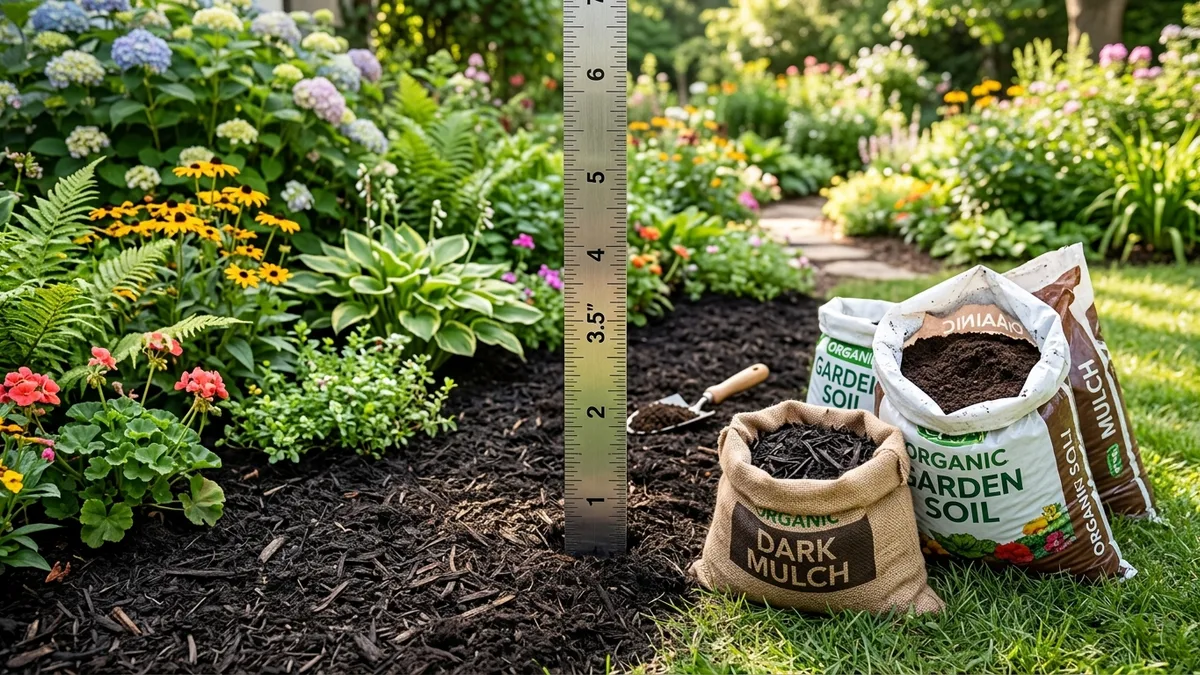 Volume & Area
How Many Sq Feet in a Cubic Foot? Coverage Depends on Depth
Find how many square feet one cubic foot covers at different depths. See a clear coverage chart, bag examples, and why area and volume have no fixed conversion.
 Unit Conversion
Converter Meter to Square Feet: Get the Right Area Conversion
Convert square meters to square feet with accurate formulas and examples. Learn when meter measurements need a width, plus tables, room calculations, and tips.
 Volume & Area
How Do I Find the Cubic Feet? A Practical Measuring Guide
Learn how to find cubic feet from feet, inches, or metric measurements. Get clear examples for boxes, rooms, cylinders, and spaces with uneven dimensions.
Calculate Your Project in Seconds
Whether you're pouring concrete, spreading garden mulch, or estimating freight container volume, our instant calculator provides exact answers with zero guesswork.