
Cubic Feet to Tons: Calculate Material Weight Using Density
Convert cubic feet to tons using material density. Compare short tons and metric tonnes, follow worked examples, and estimate gravel, sand, or soil weight.
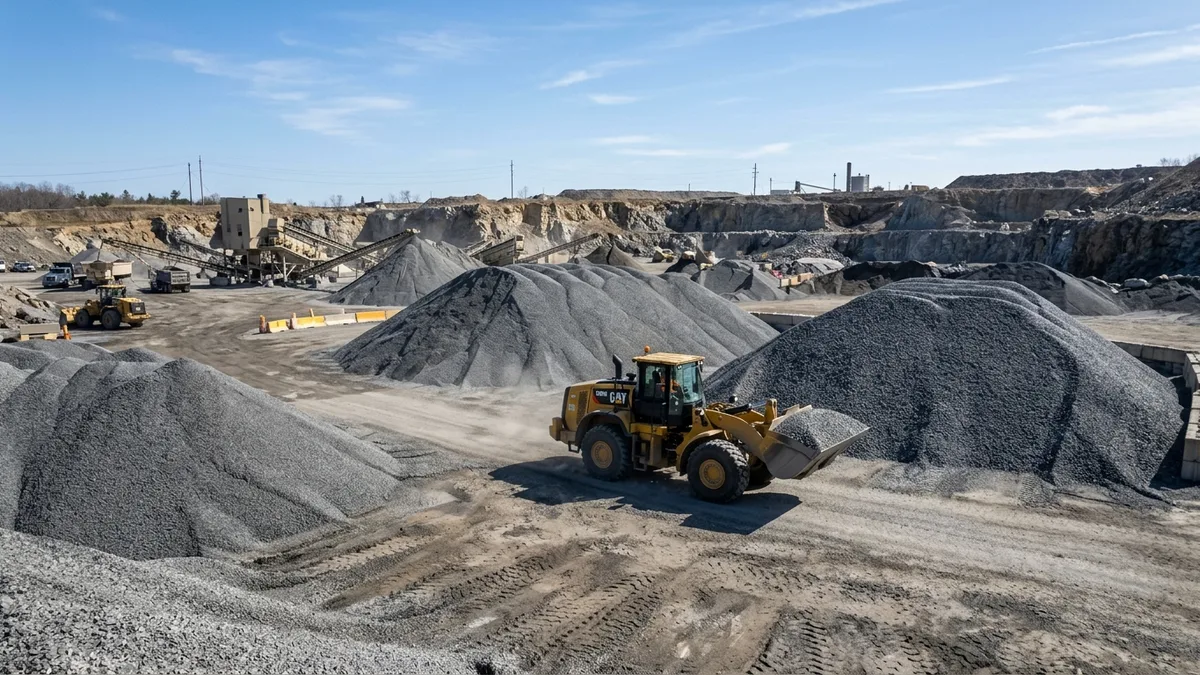
Aggregate quarry with neat stockpiles of crushed stone and yellow loader truck under bright sky
Table of Contents (24 sections) ▼
- Quick Answer: Volume × Density Gives Weight
- Select the Ton Type Before Doing the Arithmetic
- Enter the Right Inputs Into a Cubic Feet to Tons Calculator
- Find Bulk Density That Matches Your Material
- Follow the Formula With Clearly Stated Assumptions
- Gravel using one assumed density
- Sand using a density range
- Soil using a cubic-yard reference
- Calculate With Metric Density or Metric Tonnes
- Example with metric density
- Example with density in pounds
- Understand Moisture, Compaction, and Measurement Uncertainty
- Read a Weight Estimate Alongside an Actual Delivery
- Reverse the Calculation and Avoid Unrelated “Tons”
- Refrigeration capacity is a separate quantity
- A register ton is a volume unit
- Questions About Material Tonnage
- Can you convert volume to tons without density?
- How many cubic feet are in a ton of gravel?
- How much does one cubic foot of sand weigh?
- Why do different calculators give different tonnage?
- Can I use this formula for concrete?
- Is one metric tonne equal to one short ton?
- Keep the Density Assumption Attached to the Result
To convert cubic feet to tons, multiply the volume by the material’s density, then divide by the weight represented by your chosen ton. For a U.S. short ton, use pounds per cubic foot and divide by 2,000. For example, 64 cubic feet at an assumed density of 100 lb/ft³ weighs 3.2 short tons.
The density is the part you cannot skip. Equal-sized piles of gravel, soil, and lightweight mulch can have very different weights. Even the same material can vary with moisture, particle size, and how tightly it is packed.
This calculation helps connect a measured volume to a material order, transport estimate, or weight-based quote. The sections below explain which ton to select, where density values come from, and how to keep an estimate separate from a measured delivery weight. You will also find examples using both customary and metric inputs.
Quick Answer: Volume × Density Gives Weight
For U.S. short tons, multiply cubic feet by density in pounds per cubic foot and divide by 2,000. The result depends on the material and its condition. There is no universal conversion factor because cubic feet measure volume, while tons express mass rather than space.
Always report the density assumption and ton type with the result. “3.2 short tons at 100 lb/ft³” communicates more than “3.2 tons.”
Select the Ton Type Before Doing the Arithmetic
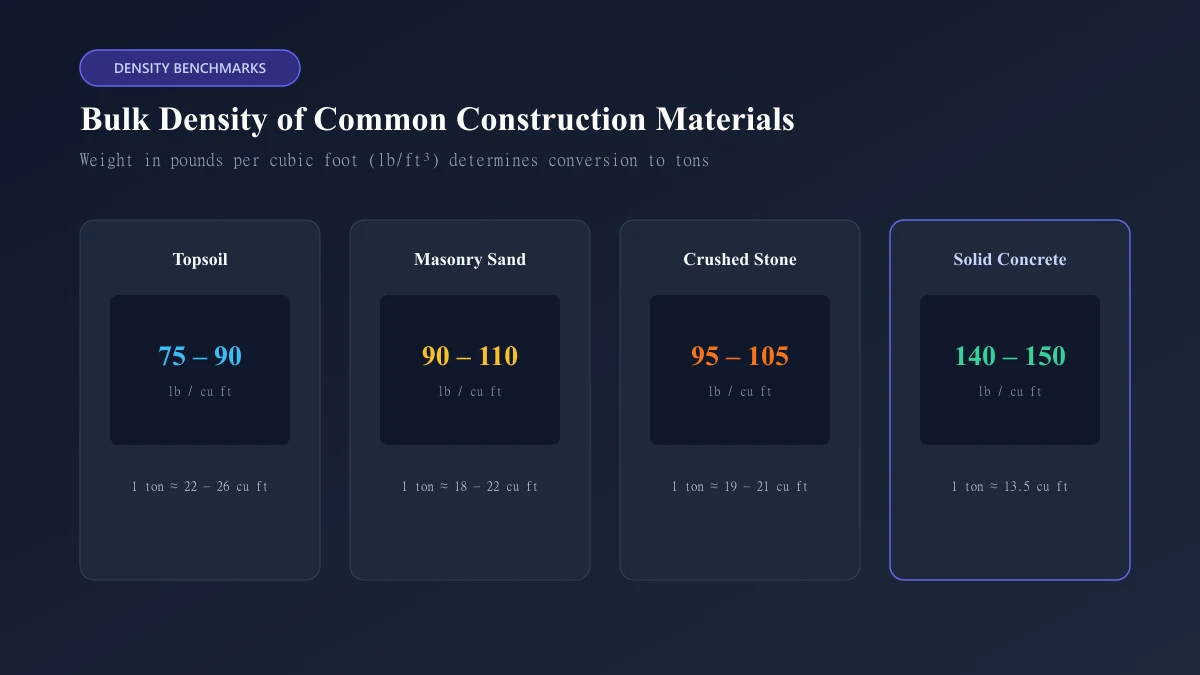
The word “ton” can describe different quantities. For material weight, three units matter most:
| Unit | Definition | Divisor when weight is in pounds |
|---|---|---|
| U.S. short ton | 2,000 pounds | 2,000 |
| Metric tonne | 1,000 kilograms | Approximately 2,204.62262 |
| Long ton | 2,240 pounds | 2,240 |
NIST lists these as separate mass units. The metric tonne is also called a metric ton. Its symbol is t. The long ton is a separate unit; do not assume a quote uses it simply because the supplier is outside the United States.
Confirm the unit written on the quotation, product data, or scale ticket. A calculated 2,000-pound load equals one short ton, approximately 0.907 metric tonnes, or approximately 0.893 long tons.
In everyday material calculations, people often call the result “weight.” More precisely, pounds and the ton units above express mass in this context. The formulas here estimate how much material is present, not a force measured in newtons.
Enter the Right Inputs Into a Cubic Feet to Tons Calculator
A useful calculator needs a volume, a density value, and a selected output unit. A material menu can supply a reference density, but it should identify what that value assumes.
Before calculating:
- Establish the volume. Use the quantity supplied or calculate the relevant dimensions.
- Match the material. Gravel, crushed stone, sand, and soil are not interchangeable categories.
- Check the condition. Identify whether the density describes dry, moist, loose, or compacted material.
- Check density units. Pounds per cubic foot and kilograms per cubic meter need different handling.
- Choose the ton type. Select short tons, metric tonnes, or long tons explicitly.
For a rectangular layer, volume is length × width × depth, with all dimensions in feet. If the depth is in inches, divide that dimension by 12 first.
Do not count the entire container when it is only partly filled. Also avoid using the rectangular boundary around an irregular heap as though every part of that boundary contains material.
Find Bulk Density That Matches Your Material
Material density links volume and mass. For a pile of loose particles, you usually need bulk density, which includes the spaces between those particles.
A stone’s solid density describes the stone itself. Applying that value to an entire gravel pile would ignore the air gaps and could overstate its aggregate weight.
Start with a supplier’s product-specific bulk density or volume-to-weight factor. Ask whether it applies to the delivered condition or the final installed condition.
A supplier may quote short tons per cubic yard instead of pounds per cubic foot. You can work directly with that factor: convert your cubic feet to cubic yards by dividing by 27, then multiply by the stated tons per yard. For example, 90 cubic feet at an assumed 1.4 short tons per cubic yard gives 90 ÷ 27 × 1.4, or approximately 4.67 short tons. This avoids an unnecessary intermediate density conversion. Check that “per yard” means cubic yard and that the quoted factor uses the same ton definition as your output.
Published references are useful when better information is unavailable, but they remain estimates. The EPA’s archived volume-to-weight table compiles values from several underlying sources. Some entries describe one cubic foot, while others describe one cubic yard.
These selected entries illustrate why labels matter:
| Reference material condition | Weight listed in the EPA table | Equivalent density |
|---|---|---|
| Gravel, dry | 100 lb per cubic foot | 100 lb/ft³ |
| Gravel, wet | 100–120 lb per cubic foot | 100–120 lb/ft³ |
| Sand, dry | 90–110 lb per cubic foot | 90–110 lb/ft³ |
| Soil/sandy loam, loose | 2,392 lb per cubic yard | Approximately 88.59 lb/ft³ |
These are reference entries, not guaranteed values for every product with that name. The soil figure requires division by 27 because one cubic yard contains 27 cubic feet.
Follow the Formula With Clearly Stated Assumptions
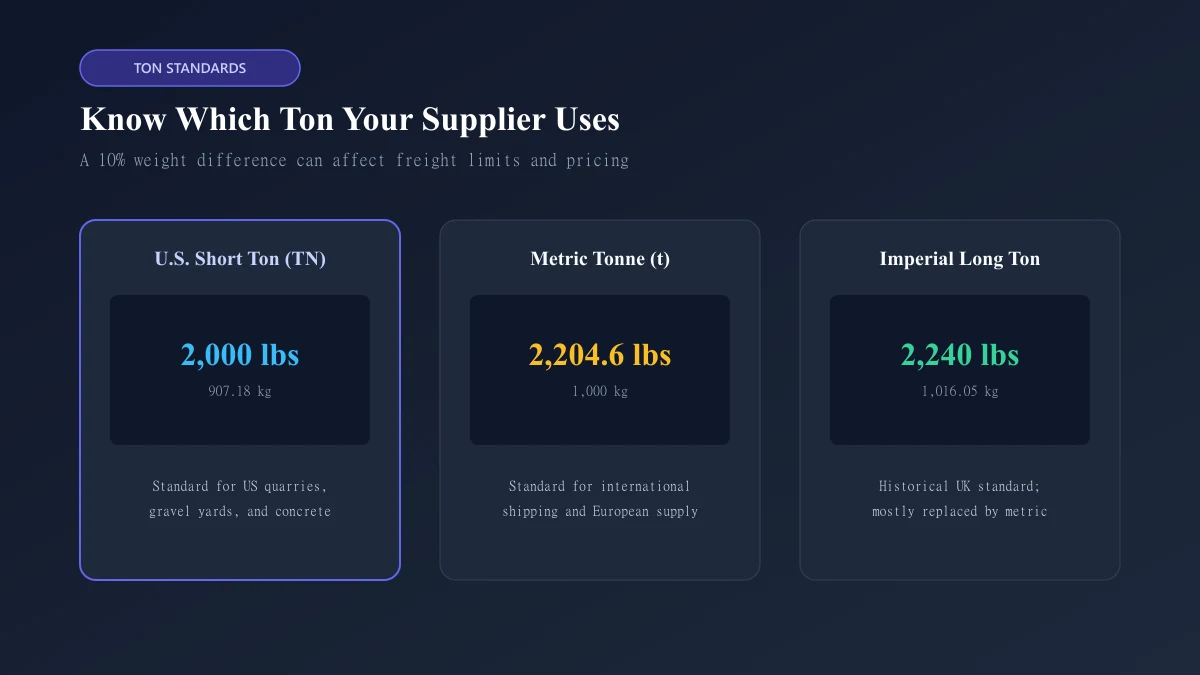
The first step in a volume to weight conversion is:
For short tons, divide the pounds by 2,000. Keeping those steps separate makes the result easier to check.
Gravel using one assumed density
Suppose you have 64 cubic feet of gravel and use 100 lb/ft³ as the density:
A gravel weight calculator should show that the 100 lb/ft³ input controls the estimate. It does not establish the exact weight of your particular pile.
Sand using a density range
For 42 cubic feet of dry sand, apply the EPA reference range of 90–110 lb/ft³:
Reporting approximately 1.89–2.31 short tons reflects the uncertainty in sand weight better than selecting an unexplained midpoint.
Soil using a cubic-yard reference
Suppose you need a soil weight estimate for 81 cubic feet and use the listed loose soil/sandy loam factor of 2,392 pounds per cubic yard.
First express the volume in the matching unit:
Then calculate:
You might report about 3.59 short tons with the reference assumption stated. Using the original per-yard factor avoids rounding its per-foot equivalent too early.
Calculate With Metric Density or Metric Tonnes
Some material data uses kilograms per cubic meter, written kg/m³. Convert the volume to cubic meters before multiplying by that density.
Then:
Example with metric density
Assume 96 cubic feet of a material with a stated bulk density of 1,600 kg/m³:
Metric tonnes ≈ 4.34947
Report approximately 4.35 tonnes, preserving full precision during the calculation.
Example with density in pounds
You can also calculate cubic feet to metric tonnes while keeping density in lb/ft³:
For the earlier 6,400-pound gravel estimate:
6,400 ÷ 2,204.62262 ≈ 2.903 tonnes
This is the same estimated material quantity expressed in a different mass unit. It does not mean the load has changed.
Understand Moisture, Compaction, and Measurement Uncertainty
Density changes can affect the result as much as the measured volume. Moisture content affects mass, and packing changes how much material occupies each unit of bulk volume.
Compaction does not create extra solid material. It generally reduces air spaces, so the same material occupies a smaller volume and has a higher bulk density in that condition.
If you measure compacted volume, use a density appropriate to that state. If you calculate a loose delivery, use a factor for loose material. Mixing compacted volume with a loose density can misrepresent the mass.
Consider a purely illustrative case: a load weighs 5,000 pounds and occupies 50 cubic feet when loose. Its bulk density is 100 lb/ft³. If the same mass occupies 40 cubic feet after compaction, its density is 125 lb/ft³.
Both calculations produce 2.5 short tons when the corresponding volume and density are paired correctly.
Avoid adding an arbitrary moisture correction to a density that already represents wet material. That can double count the effect. When the condition is uncertain, ask for a suitable density range and keep the output approximate.
Read a Weight Estimate Alongside an Actual Delivery
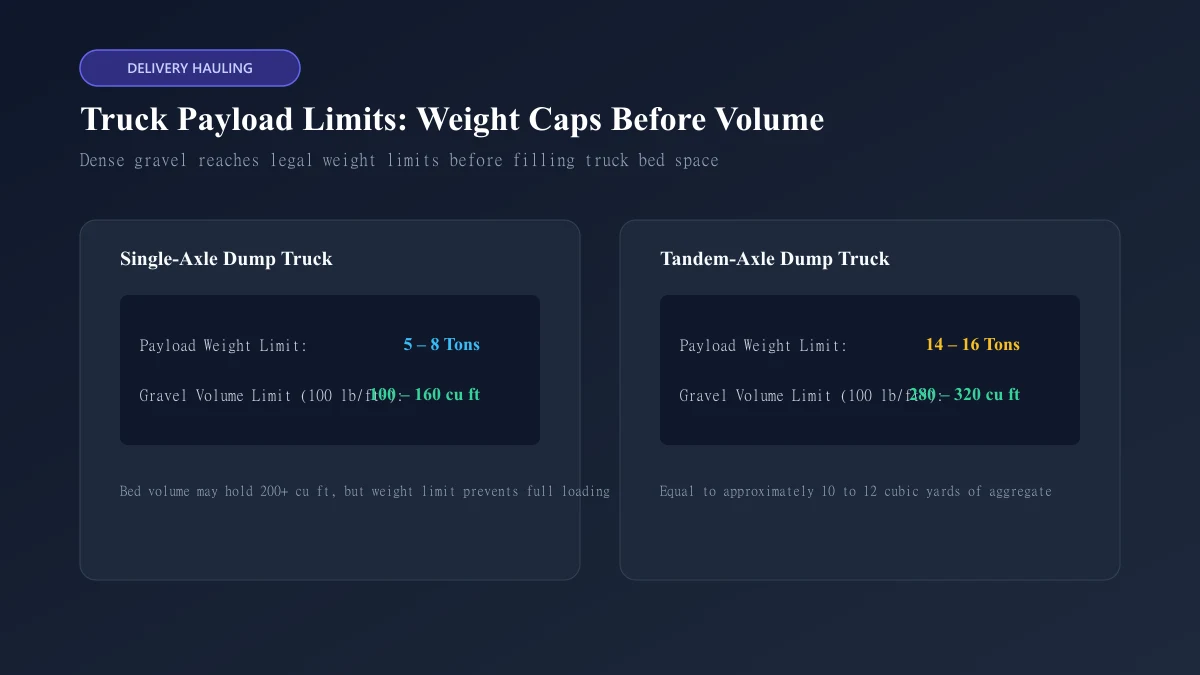
A calculation helps with planning. A measured delivery weight provides different evidence: it reflects what was weighed, rather than what was inferred from volume.
On a weighbridge ticket, net weight is generally the difference between loaded gross weight and tare weight, the vehicle’s empty or reference weight.
If gross weight is 18,700 pounds and tare weight is 12,900 pounds:
Check the ticket’s unit labels and what was included in the weighing. A volume-based estimate may differ because the actual material condition or quantity differs from the assumptions.
For transport planning, compare the load with the vehicle or trailer’s applicable load capacity. Include other cargo and equipment that count toward the limit. An uncertain density estimate should not be treated as proof that a load is within that limit.
Reverse the Calculation and Avoid Unrelated “Tons”
To work backward from tons to cubic feet, you still need density:
At 100 lb/ft³, one short ton occupies 20 cubic feet. At 125 lb/ft³, it occupies 16 cubic feet. Both answers can be correct for their stated assumptions.
Refrigeration capacity is a separate quantity
A refrigeration ton expresses cooling capacity, not material mass. You cannot select an air-conditioning unit by applying a soil or gravel density formula to a room’s volume. That task needs a cooling-load assessment.
A register ton is a volume unit
A register ton is a historical shipping volume unit equivalent to 100 cubic feet. It is separate from short tons, long tons, and metric tonnes of material mass.
If a calculator divides cubic feet by 100, check whether it is calculating register tons. That operation does not give the mass of gravel or soil.
Questions About Material Tonnage
Can you convert volume to tons without density?
Not for an ordinary material mass estimate. Volume tells you how much space is occupied; density tells you how much mass occupies that space. If a tool works from a material name alone, it is using a preset density. Check that value and its assumed condition before relying on the result.
How many cubic feet are in a ton of gravel?
At an assumed bulk density of 100 lb/ft³, one U.S. short ton occupies 20 cubic feet. At 120 lb/ft³, it occupies about 16.67 cubic feet. The answer depends on the gravel and ton unit. Ask the supplier for its product-specific factor when planning an actual order.
How much does one cubic foot of sand weigh?
The EPA reference table lists dry sand at 90–110 pounds per cubic foot. That corresponds to approximately 0.045–0.055 short tons. Treat the figures as a reference range, not a guarantee. Moisture and the specific sand product can change the weight, so use matching supplier data when available.
Why do different calculators give different tonnage?
They may use different material densities, loose or compacted conditions, moisture assumptions, or ton definitions. Compare the actual inputs before deciding that one calculation is wrong. Identical volume, density, and output units should produce the same result apart from rounding. A hidden preset can explain a large difference.
Can I use this formula for concrete?
Yes, if the density matches the concrete condition you are measuring. Fresh concrete, hardened concrete, dry bagged mix, and loose broken concrete are different inputs. For a material stated at 150 lb/ft³, 32 cubic feet equals 2.4 short tons. That is an assumed-density example, not a universal concrete factor.
Is one metric tonne equal to one short ton?
No. One metric tonne equals 1,000 kilograms, or approximately 2,204.62 pounds. One short ton equals 2,000 pounds. A metric tonne is therefore larger. Label the unit on estimates and orders so a supplier does not interpret the same numerical quantity as a different amount of material.
Keep the Density Assumption Attached to the Result
Converting cubic feet to tons starts with three things: measured volume, matching material density, and a clearly identified ton unit. Calculate the mass, retain sensible precision, and state whether the answer is an estimate or a measured quantity.
For a purchase or delivery, confirm the product’s condition and the supplier’s units. That makes the calculation useful beyond the calculator display.
Related Topics
Written by BigTechies Editorial Team
BigTechies develops accurate, practical calculation and unit conversion tools for contractors, designers, architects, and DIY homeowners. Every formula and reference guide is reviewed for dimensional consistency and mathematical precision.
Related Articles
Continue exploring practical measurement guides
 Volume & Area
How Many Sq Feet in a Cubic Foot? Coverage Depends on Depth
Find how many square feet one cubic foot covers at different depths. See a clear coverage chart, bag examples, and why area and volume have no fixed conversion.
 Unit Conversion
Converter Meter to Square Feet: Get the Right Area Conversion
Convert square meters to square feet with accurate formulas and examples. Learn when meter measurements need a width, plus tables, room calculations, and tips.
 Volume & Area
How Do I Find the Cubic Feet? A Practical Measuring Guide
Learn how to find cubic feet from feet, inches, or metric measurements. Get clear examples for boxes, rooms, cylinders, and spaces with uneven dimensions.
Calculate Your Project in Seconds
Whether you're pouring concrete, spreading garden mulch, or estimating freight container volume, our instant calculator provides exact answers with zero guesswork.