
Volume of a Rectangular Prism: Formula and Worked Examples
Find the volume of a rectangular prism using length, width, and height. Learn the formula with clear examples, fractions, missing dimensions, and unit checks.
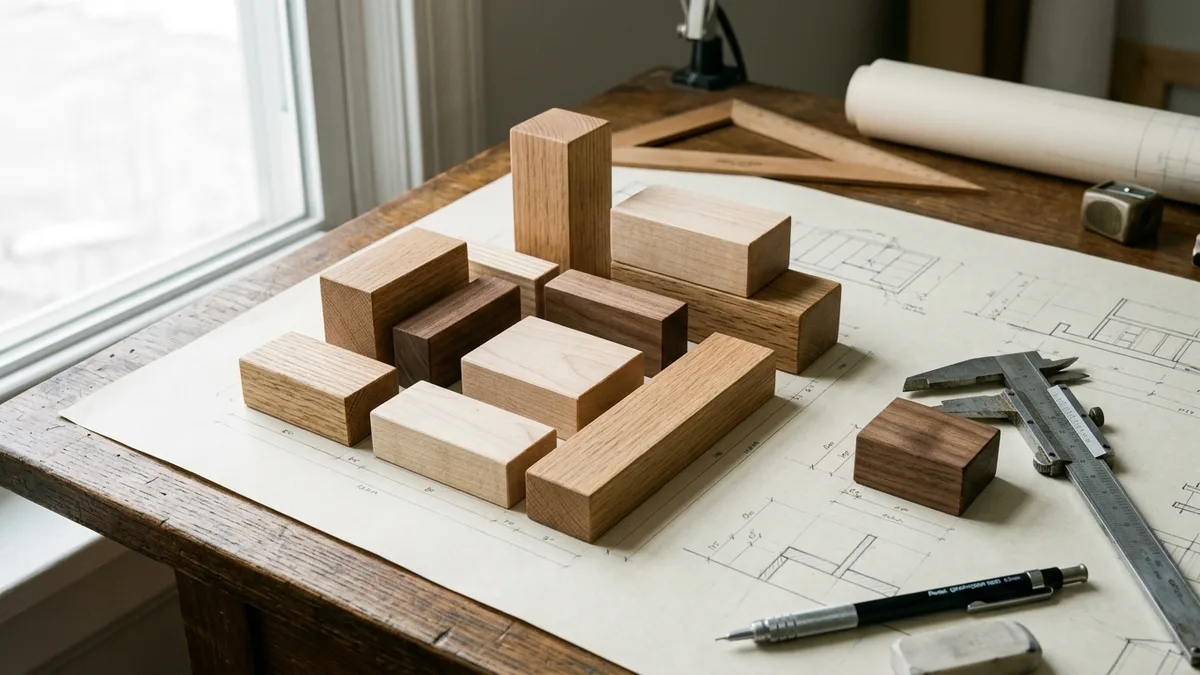
Finished natural wood rectangular prism blocks and drafting tools on an architect workbench
Table of Contents (21 sections) ▼
- Quick Answer: Three Dimensions Give the Volume
- Recognizing the Shape and Its Measurements
- Why Counting Cube Layers Leads to the Formula
- The Volume of a Rectangular Prism Formula in Practice
- Solved Problems With Decimals and Fractions
- Decimal Edge Lengths
- Fractional Edge Lengths
- Recovering a Missing Edge From the Volume
- Matching Units Before You Multiply
- Using a Calculator Without Losing the Method
- Joining Prisms and Comparing Their Sizes
- Volume, Surface Area, and Capacity Answer Different Questions
- Questions Students Ask About Rectangular Prism Volume
- Can You Find Volume With Only Two Dimensions?
- Is a Cube a Rectangular Prism?
- Does Turning the Prism Change Its Volume?
- Why Are Volume Answers Written in Cubic Units?
- What If the Problem Gives Base Area Instead of Width?
- Can Volume Be Smaller Than One Cubic Unit?
- Can the Volume of a Box Tell Me Whether an Item Fits?
- Check the Dimensions, Then Check the Units
The volume of a rectangular prism is found by multiplying its length, width, and height. A prism measuring 9 cm long, 4 cm wide, and 5 cm high has a volume of 180 cm³. All three measurements must use the same length unit before you multiply.
The formula is short, but understanding it helps with more than a basic homework question. It explains how many unit cubes fit inside a solid, how to work with fractional measurements, and how to recover a missing side when the volume is already known.
It also helps you distinguish the space a box occupies from the material needed to cover its faces. Those are different measurements with different formulas. Start with the shape and its three dimensions, then choose the calculation that answers your question. The examples below show each step and the units that belong in the final answer.
Quick Answer: Three Dimensions Give the Volume
For a right rectangular prism, multiply length × width × height: V = lwh. Measure all three dimensions in the same unit, then report the answer in cubic units. Alternatively, multiply the rectangular base area by the perpendicular height: V = Bh. Both methods give the same volume.
Recognizing the Shape and Its Measurements
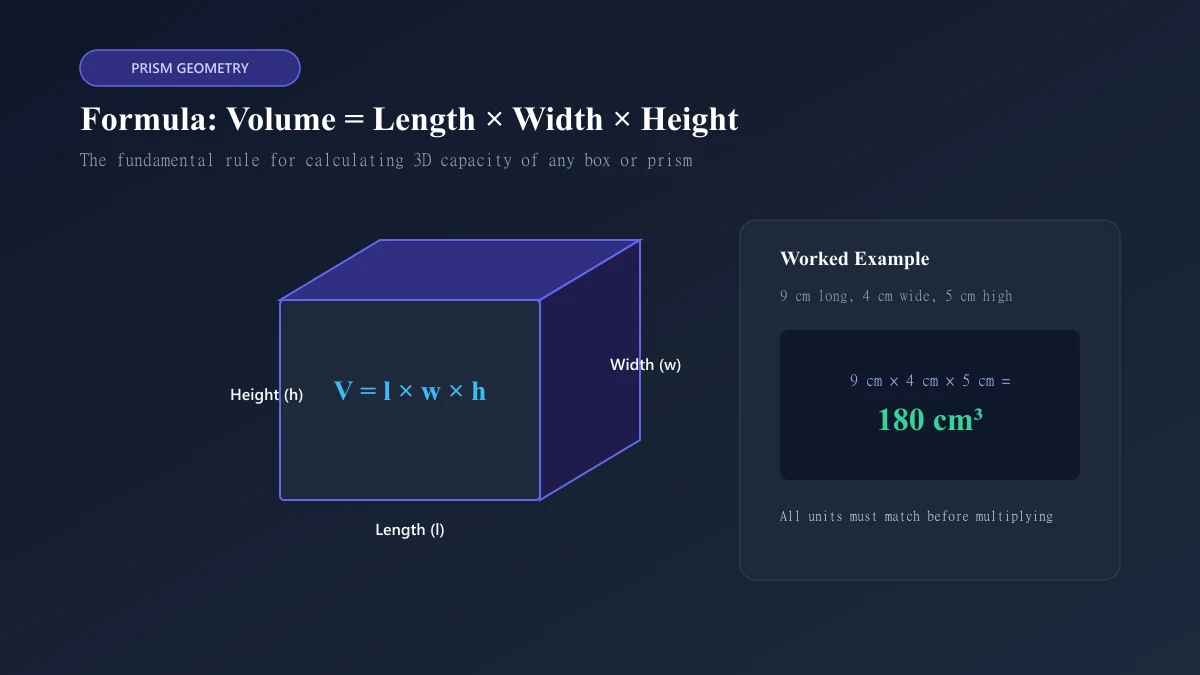
A right rectangular prism is a box-shaped, three-dimensional solid with six rectangular faces. It has 12 edges and eight vertices, or corners. Its faces meet at right angles. Another common name is cuboid, so the volume of a cuboid uses the same calculation.
The three dimensions are length, width, and height. In a diagram, length and width often describe the base, while height extends from that base to the opposite face. Depending on the object’s position, a measurement may be called depth instead.
The labels are less important than choosing three mutually perpendicular edge lengths. A slanted line across a face or through the solid is a diagonal, not one of those three edges.
A drawing may show only three faces, but hidden faces still belong to the solid. Likewise, the height label may sit beside a rear edge. Follow the label to the edge it describes rather than estimating a measurement from how the picture looks.
Why Counting Cube Layers Leads to the Formula
Imagine a prism made from small cubes, each with edges one unit long. Every unit cube occupies one cubic unit of space.
Suppose the bottom layer contains five cubes along its length and three along its width. That layer contains:
Stack four identical layers:
The solid therefore has a volume of 60 cubic units. Multiplying the three edge lengths gives exactly the same result:
This layer model explains why multiplication works. Length times width counts the cubes in one layer; multiplying by height counts all the layers. Cubes must fill the solid without gaps or overlaps.
It also explains why the answer is cubed. Three length measurements are multiplied together, so the units become unit × unit × unit. If the cube edges measure one centimeter, each cube has a volume of one cubic centimeter.
Fractional edge lengths extend the same idea using smaller cubes. The formula continues to work even when whole unit cubes cannot fill the shape exactly.
The Volume of a Rectangular Prism Formula in Practice
The rectangular prism volume formula is:
Here, V represents volume, l represents length, w represents width, and h represents height.
You can also write:
B is the area of the rectangular base. It already contains two dimensions, so multiplying it by height supplies the third.
Use this method to solve a problem:
- Identify the three edge lengths, or the base area and height.
- Convert mixed measurements to compatible units.
- Substitute the values into the formula.
- Multiply and attach the correct cubic unit.
For the opening example:
Using the base-area method gives:
Notice that cm² × cm becomes cm³. Adding the dimensions, such as 9 + 4 + 5, would not measure the space enclosed by the solid.
For a leaning prism with a rectangular base, V = Bh uses perpendicular height. The slanted connecting edge is not generally the height. The examples here use right prisms, where the vertical edge and perpendicular height coincide.
Solved Problems With Decimals and Fractions
Decimal Edge Lengths
A display case has internal dimensions of 2.4 m by 1.5 m by 0.8 m. Assuming a rectangular interior:
First calculate its base area:
Then multiply by height:
The dimensions are all in meters, so the answer is cubic meters. Decimal measurements do not change the formula. Keep the decimal places during the calculation and round only if the problem requests it or the measurements justify rounding.
Fractional Edge Lengths
A small rectangular solid measures 2½ inches by 1⅓ inches by ¾ inch.
Convert the mixed numbers to improper fractions:
Substitute:
Cancel common factors or multiply the numerators and denominators:
Fractional dimensions can produce a fractional volume. That is a valid result, not a sign that the method failed. Keeping the fractions exact avoids rounding a repeating decimal such as 1⅓ too early.
These problems show two ways to handle fractional edge lengths: multiply decimals directly when they are given, or simplify fractions when exact fractions are provided.
Recovering a Missing Edge From the Volume
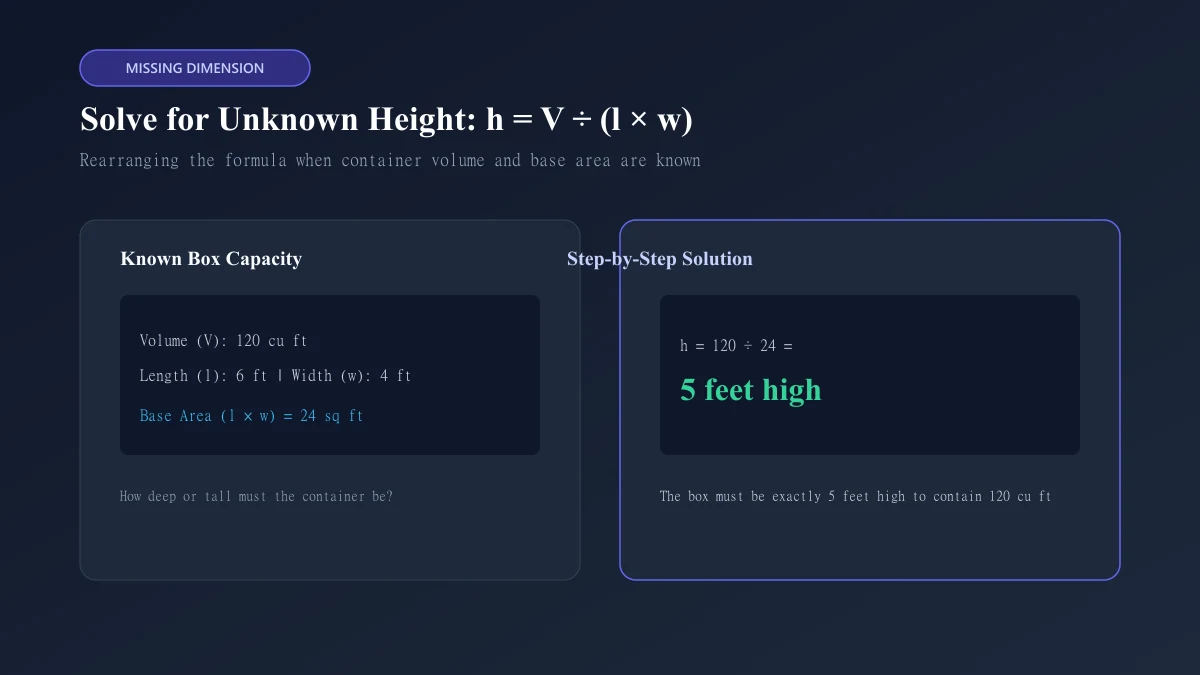
When volume and two dimensions are known, divide by the product of those dimensions.
| Missing measurement | Rearranged formula |
|---|---|
| Height | h = V/(lw) |
| Width | w = V/(lh) |
| Length | l = V/(wh) |
Suppose a prism has a volume of 252 cm³, a length of 9 cm, and a width of 7 cm. Its base area is:
Therefore:
The missing height uses centimeters, not cubic centimeters. Dividing volume by area leaves a length unit.
Here is how to find the missing width of a rectangular prism. A container has a volume of 336 in³, a length of 8 inches, and a height of 6 inches:
Check by substituting the answer back:
This check catches incorrect division and misplaced dimensions. If only volume and one edge are given, you usually need another measurement or relationship to determine the other two edges uniquely.
Matching Units Before You Multiply
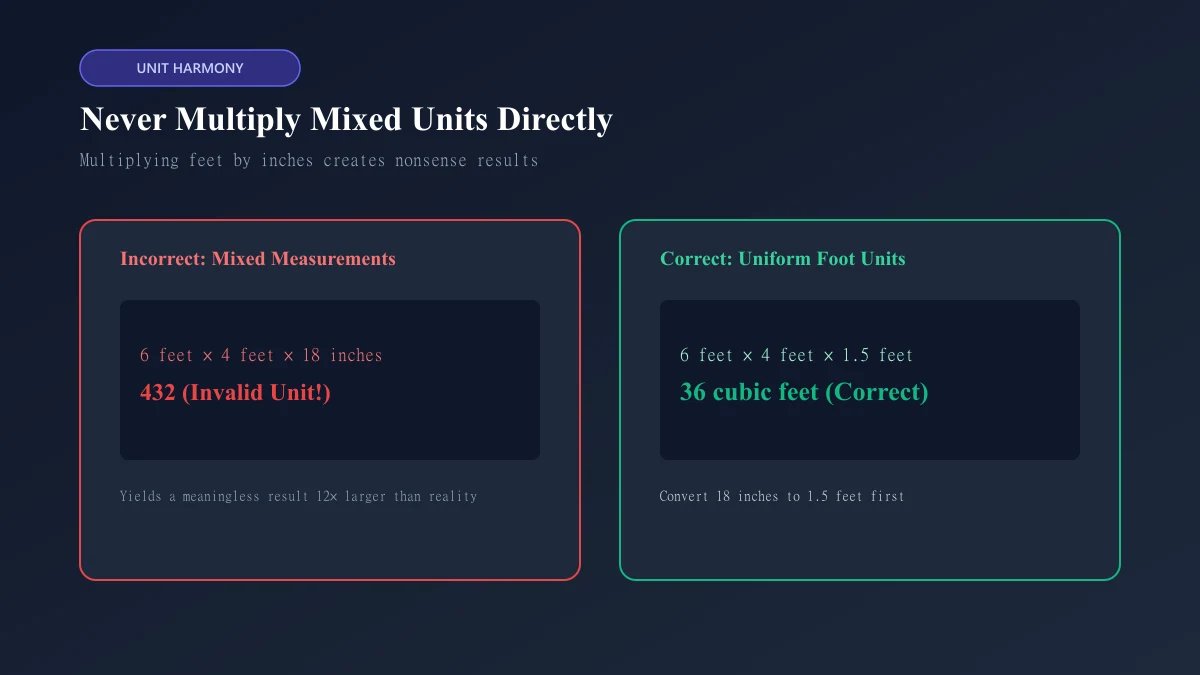
A prism measures 0.7 m long, 40 cm wide, and 25 cm high. Multiplying 0.7 × 40 × 25 directly would combine meters and centimeters.
Convert the length to centimeters first:
Now calculate:
Alternatively, convert width and height to meters:
Both answers describe the same volume. One cubic meter contains 1,000,000 cubic centimeters because 100 × 100 × 100 = 1,000,000.
This is a common source of errors: a linear conversion factor must be cubed when converting a cubic unit. Similarly, 1 ft³ equals 12³, or 1,728 in³, rather than 12 in³.
When you start with a base area, its unit must match the height. A base area in cm² paired with a height in centimeters produces cm³. Convert first if the height is in another unit.
Using a Calculator Without Losing the Method
A rectangular prism volume calculator can handle the arithmetic once you enter length, width, and height. You may also see the tool called a box volume calculator.
Check how it handles units. Some calculators convert separately selected input units; others expect every entered value to use one common unit. A unit label alone does not prove that mixed measurements are converted automatically.
For a quick check, enter 3, 4, and 5 using the same unit. The displayed volume should be 60 cubic units. If you change only the height from 5 to 10, the result should become 120.
For homework, keep the formula and substituted values in your working. A calculator answer alone may hide a wrong measurement or an incorrect unit choice.
For real containers, measure internal dimensions when finding capacity. External dimensions describe the enclosing box-shaped space and include wall thickness. Rounded corners, partitions, or other features can make usable capacity smaller than the simple rectangular estimate.
Joining Prisms and Comparing Their Sizes
Composite solids contain more than one simple shape. For a solid made from non-overlapping rectangular prisms, calculate each part separately and add the results.
Suppose an L-shaped solid can be divided into two parts:
- Part A: 7 cm × 3 cm × 2 cm = 42 cm³.
- Part B: 3 cm × 3 cm × 4 cm = 36 cm³.
The parts can share a face, but they must not occupy the same space. If your chosen boxes overlap, adding their full volumes counts the overlap twice. Another method is to calculate a larger enclosing prism and subtract a missing rectangular section.
Equal volume also does not require identical dimensions. A 10 × 3 × 4 cm prism and an 8 × 5 × 3 cm prism both have a volume of 120 cm³. One may still be too wide or too tall for a particular opening.
Finally, consider what happens to volume when all dimensions are doubled:
The volume becomes eight times as large. More generally, a uniform scale factor k changes volume by k³. Doubling only one dimension doubles volume; doubling two dimensions multiplies it by four.
Volume, Surface Area, and Capacity Answer Different Questions
Rectangular prism volume word problems often require you to identify the measurement before calculating it. Filling a rectangular space asks about volume. Covering all its faces asks about surface area.
| Measurement | What it describes | Formula for a right rectangular prism | Unit type |
|---|---|---|---|
| Volume | Three-dimensional space | V = lwh | Cubic units |
| Surface area | Total area of six faces | SA = 2(lw + lh + wh) | Square units |
| Internal capacity | Space available inside a rectangular container | Internal length × internal width × internal height | Cubic units or liquid-volume units |
For a solid measuring 6 cm by 4 cm by 2 cm:
Those answers cannot replace one another. The first measures space; the second measures the combined faces.
Read the wording carefully. An open-top container has no top face to cover, so its required material area differs from the six-face surface-area formula. A partly filled container also requires the actual fill depth when calculating the volume of its contents.
Questions Students Ask About Rectangular Prism Volume
Can You Find Volume With Only Two Dimensions?
Usually, two edge lengths are not enough. You need the third edge, or information that determines it. However, base area and height are sufficient because the area already combines two dimensions. A condition such as “the base is square” can also supply a missing relationship in some problems.
Is a Cube a Rectangular Prism?
Yes. A cube is a special right rectangular prism with all edges equal. Its square faces are also rectangles. If each edge has length s, the volume formula becomes V = s × s × s = s³. A rectangular prism does not require all three dimensions to be different.
Does Turning the Prism Change Its Volume?
No. Rotating a rigid prism changes its position, not the space it occupies. What you call length, width, and height may change, but their product stays the same. For example, 2 × 4 × 7 and 7 × 2 × 4 both equal 56 cubic units.
Why Are Volume Answers Written in Cubic Units?
Volume measures space in three dimensions. Multiplying length, width, and height multiplies three length units, producing a cubic unit. A cubic centimeter represents the space of a cube with one-centimeter edges. Square centimeters measure area, so they are not the correct unit for a three-dimensional volume answer.
What If the Problem Gives Base Area Instead of Width?
Use V = Bh, where B is the base area and h is the perpendicular height. You do not need to recover the separate length and width. For example, a rectangular base of 18 cm² and a height of 7 cm give a volume of 126 cm³.
Can Volume Be Smaller Than One Cubic Unit?
Yes. A prism with fractional edges can occupy less than one cubic unit. For example, dimensions of ½ cm, ½ cm, and ½ cm give a volume of ⅛ cm³. The size of the answer depends on the dimensions and the measurement unit you choose.
Can the Volume of a Box Tell Me Whether an Item Fits?
Volume alone cannot guarantee fit. Compare the item’s dimensions with the box’s internal dimensions and consider its orientation. A long object may have a smaller volume than the box while extending beyond its available length. The opening, padding, and any internal divisions can also limit usable space.
Check the Dimensions, Then Check the Units
Finding the volume of a rectangular prism starts with identifying three perpendicular dimensions or a base area and height. Use compatible units, multiply carefully, and report cubic units. When a side is missing, rearrange the formula and verify the result by substitution. Understanding the layers behind the calculation makes the method easier to apply to fractions, composite shapes, and practical measurement problems.
Related Topics
Written by BigTechies Editorial Team
BigTechies develops accurate, practical calculation and unit conversion tools for contractors, designers, architects, and DIY homeowners. Every formula and reference guide is reviewed for dimensional consistency and mathematical precision.
Related Articles
Continue exploring practical measurement guides
 Volume & Area
How Many Sq Feet in a Cubic Foot? Coverage Depends on Depth
Find how many square feet one cubic foot covers at different depths. See a clear coverage chart, bag examples, and why area and volume have no fixed conversion.
 Unit Conversion
Converter Meter to Square Feet: Get the Right Area Conversion
Convert square meters to square feet with accurate formulas and examples. Learn when meter measurements need a width, plus tables, room calculations, and tips.
 Volume & Area
How Do I Find the Cubic Feet? A Practical Measuring Guide
Learn how to find cubic feet from feet, inches, or metric measurements. Get clear examples for boxes, rooms, cylinders, and spaces with uneven dimensions.
Calculate Your Project in Seconds
Whether you're pouring concrete, spreading garden mulch, or estimating freight container volume, our instant calculator provides exact answers with zero guesswork.